AI Data Privacy Risks Every Small Business Should Understand
AI tools are quietly absorbing your customer data, your contracts and your team's chat history. This is a calm, practical look at where the real privacy risks hide for a small business — and how to use AI without handing your secrets away.
 Have a nice day13 min read
Nobody in a small business sets out to leak customer data into an AI model. It happens the way most messes happen — quietly, helpfully, one harmless-looking paste at a time. Someone drops a customer email into a chatbot to draft a polite reply. Someone uploads a spreadsheet of names to “just summarise it.” Someone lets a shiny new tool read the whole shared inbox so it can be smarter. None of it feels like a decision. That's exactly why it's worth talking about.
I work with small and mid-sized companies putting AI into their day-to-day, and the privacy conversation is the one people most want to skip. It sounds like lawyers and compliance and forms — the opposite of the speed they came to AI for. But here's the thing: you don't need to become a data-protection expert. You need a clear-eyed sense of where the genuine risks are, which ones actually apply to a business your size, and a handful of habits that keep you out of trouble. That's the whole job, and it's smaller than it looks.
This isn't a scare piece, and it isn't a lecture about regulations you'll never read. It's the practical version: what data AI tools really touch, where it can go wrong, and how to keep using AI without lying awake wondering whose servers your client list is sitting on.
What actually changed when AI showed up
For years, the data your business handled mostly stayed where you put it — your accounting software, your inbox, a shared drive. Risky, sure, but contained. Generative AI quietly broke that boundary. The whole point of these tools is that you feed them your real, specific information and they do something useful with it. Which means your data is now travelling somewhere new, often to a server you don't own, in a country you didn't choose, run by a company you've never spoken to.
That's not inherently bad. Plenty of reputable AI providers handle data carefully. But the default assumptions changed, and most people never updated theirs. The mental model of “my data stays in my building” simply doesn't survive contact with a chatbot you access through a browser. Once you accept that, the rest of this gets a lot easier to reason about.
“The risk isn't that AI is evil. It's that pasting sensitive data into it feels exactly as casual as pasting it into a search box — and it absolutely isn't.”
Where your data actually goes
To reason about risk, you have to know what happens to a piece of text after you hit send. With a typical cloud AI tool, your input travels to the provider's servers, gets processed by the model, and a response comes back. Simple enough. The questions that matter are the ones nobody asks in the moment: Is that input stored? For how long? Who can see it? And is it used to train future models?
Those four questions are the entire privacy conversation in miniature. A consumer free tier and a paid business plan from the same company can answer them completely differently. The free version of a tool might retain your inputs and use them to improve the model; the business version of the very same tool often promises it won't store or train on your data at all. Same logo, very different deal. The difference lives in the plan you're on and the settings you never opened.

The risks that actually matter for a small business
Privacy guides love to list twenty threats, most of which apply to a bank, not a 12-person company. Let me cut it down to the handful that genuinely bite small businesses. These are the ones I've watched cause real headaches.
Leaking data you didn't mean to share
This is the everyday one. An employee pastes a customer's full message — name, address, order details, maybe a complaint — into a chatbot to get help replying. Harmless intent, but that personal data has now been sent to a third party, possibly stored, possibly used for training. Multiply that by a busy team over a year and you've quietly shipped a meaningful slice of your customer base to someone else's servers, with no record of it and no consent from the people involved.
Your data training someone else's model
If a tool uses your inputs to improve its model, fragments of your information can, in principle, surface elsewhere later. For most small businesses the realistic worry isn't a competitor magically extracting your price list — it's the loss of control and the consent problem. You promised customers you'd look after their data. Feeding it into a model that learns from it is hard to square with that promise, and impossible to undo.
The tool you bolted on without reading anything
The riskiest AI in your business is often the small one nobody vetted — a browser extension, a “connect your inbox” app, a free transcription tool someone found. These can request sweeping access to email, files or calendars, and many are thin wrappers around a bigger AI provider you can't see. The danger isn't the famous tools that get audited. It's the forgettable ones with broad permissions and a privacy policy nobody opened.
Confident wrong answers about real people
There's a privacy angle that gets overlooked: AI can generate plausible, wrong information about a specific person or case. If that fabricated detail ends up in a customer record, a reference or a decision that affects someone, you have both an accuracy problem and a data-protection one. Anything an AI asserts about a real individual needs a human to check it before it's treated as fact.
- Customer personal data pasted into consumer-tier tools that may store or train on it.
- Confidential contracts, pricing or strategy shared with a model you have no agreement with.
- Employee data — health notes, performance, payroll — run through general chatbots.
- Third-party AI add-ons granted broad access to your inbox, files or calendar.
- AI-generated claims about real people copied into records without a human check.
- Whole shared inboxes or drives connected to a tool nobody read the terms for.
What the rules expect (without the legal headache)
If you handle data on anyone in Europe — and almost every business does — the GDPR already applies to how you use AI. You don't need to memorise it, but a few principles translate directly into common sense. You're responsible for personal data even when a tool processes it for you. “The AI did it” is not a defence. If you hand customer data to a provider, you're expected to have a proper agreement with them covering how they handle it.
The principles that matter most in practice are the boring, sensible ones: only share data you actually need (don't paste the whole record when a snippet would do), be transparent with people about how their data is used, keep it only as long as necessary, and be able to honour requests to access or delete it. AI doesn't change those duties — it just makes them easier to forget, because the tool feels like a private assistant rather than an external company.
Cloud, private cloud, or keep it in-house?
Not all AI lives on a stranger's server. There's a spectrum, and knowing it helps you match the tool to the sensitivity of the data. At one end is the public cloud tool — fast to adopt, cheapest to start, but your data leaves your control. In the middle sits a business-grade cloud arrangement with contractual guarantees: no training on your data, clear retention, processing in a region you accept. For most small businesses, that middle option is the sweet spot for everyday work.
At the far end is running AI on your own infrastructure — on-premise or in a private environment you control — so sensitive data never leaves your walls at all. This used to be exotic and expensive. It isn't anymore. Capable open models can now run on hardware a mid-sized company can reasonably own, and for businesses handling genuinely sensitive material — health data, legal files, anything where confidentiality is the product — it's increasingly the sane default rather than a luxury.
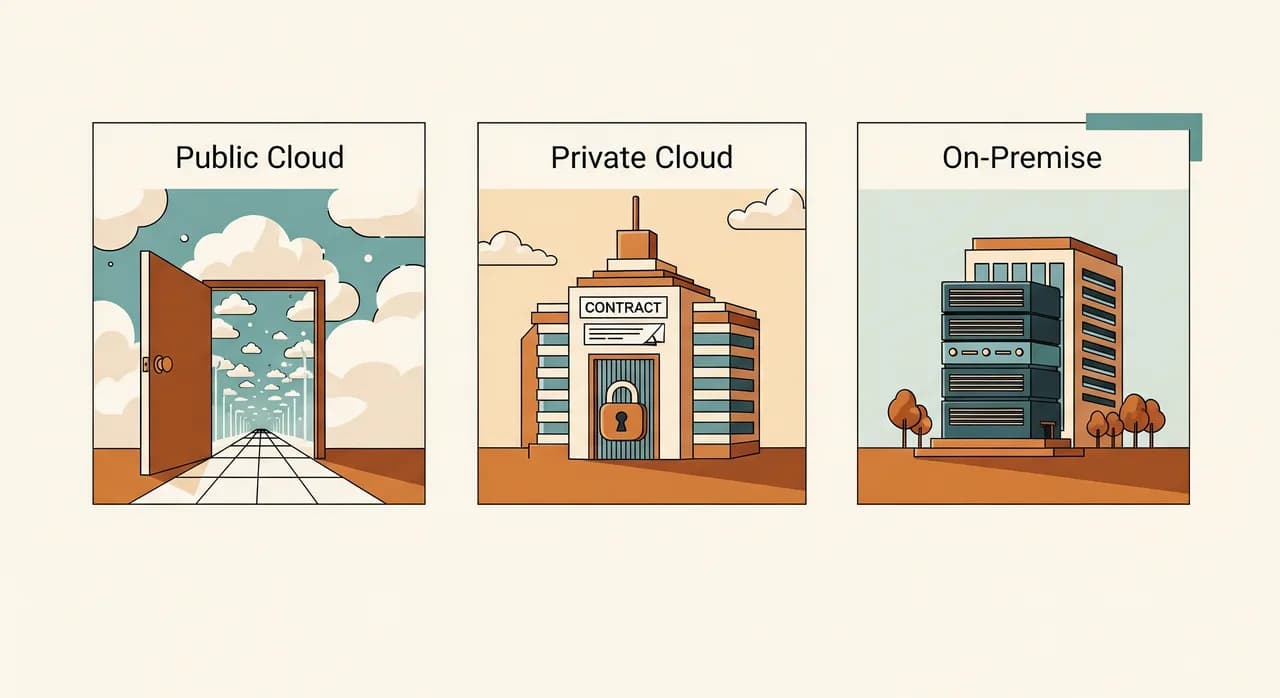
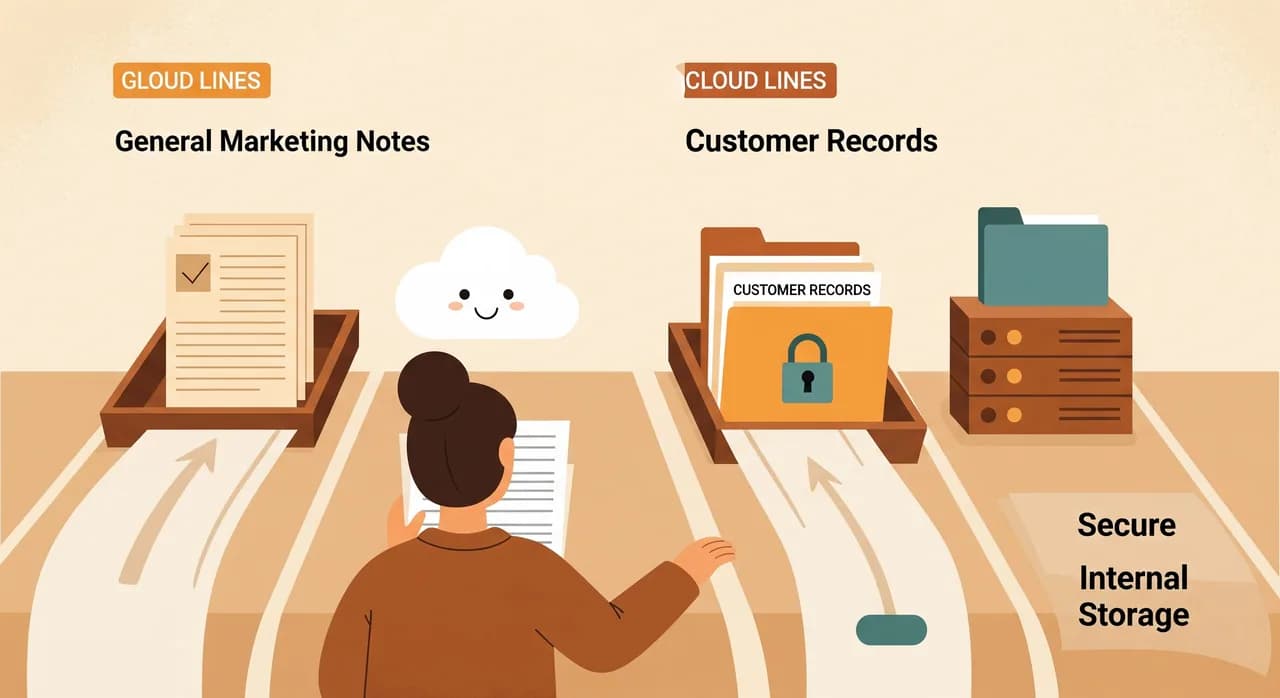
The trap is treating this as all-or-nothing. You don't have to pick one model for the whole company. The smarter pattern is to sort your data by sensitivity and route it accordingly: marketing copy and general questions can happily use a good cloud tool, while anything involving real customer records, health information or confidential contracts goes through a controlled or in-house setup. One company, two lanes.
A practical checklist you can actually run
Here's the part you can do this month without a consultant or a compliance project. None of it is heavy. It's mostly about deciding things on purpose instead of by accident.
- 1List the AI tools already in useAsk your team — honestly, no blame — what AI tools they're using, including free personal accounts and browser extensions. You can't protect data flowing through tools you don't know exist.
- 2Sort your data into sensitive and notDraw a rough line. Customer personal data, employee records, contracts and pricing on one side; general drafting, brainstorming and public info on the other. This single split drives every other decision.
- 3Move real work onto business plansFor anything touching the sensitive side, switch from consumer/free tiers to a business plan that contractually won't store or train on your data, and has a DPA.
- 4Write one short AI usage ruleHalf a page: which tools are approved, what must never be pasted into a public tool, and who to ask when unsure. Simple and read beats thorough and ignored.
- 5Lock down the sensitive laneFor genuinely confidential data, choose a controlled or on-premise setup so it never leaves your environment — and stop trying to make a public tool safe enough for it.
That's it. Five steps, none of them dramatic. The goal isn't a perfect fortress — it's removing the easy, accidental leaks that make up the overwhelming majority of real-world incidents. Get those handled and you're already ahead of most businesses your size.
The part technology can't fix
You can buy the most private setup in the world and still have a problem, because privacy in a small business is mostly about habits, not infrastructure. The leak almost never comes from a clever attacker. It comes from a helpful employee under time pressure who pastes the wrong thing into the wrong box because nobody told them not to, and because the tool made it feel completely normal.
So the highest-leverage thing you can do isn't technical at all. It's making it obvious and easy to do the right thing: one approved tool for sensitive work, a one-line rule everyone actually knows, and a culture where asking “is it okay to put this in here?” is normal rather than annoying. Technology sets the boundaries. People decide whether they're respected — and they will, if you make the safe path the easy one.
Need AI without sending your data away?
If you handle sensitive information and the cloud makes you uneasy, there's a calmer option: AI that runs in your own environment, where your data never leaves your control. We'll help you figure out what genuinely needs that — and what doesn't.
Explore private, on-premise AICommon questions
Is it safe to put customer data into ChatGPT or similar tools?
Does the GDPR apply when I use AI?
What's the difference between cloud AI and on-premise AI for privacy?
Do I really need an on-premise setup as a small business?
What's the single most important thing to do first?

Have a nice day is a software studio that helps small and mid-sized businesses go digital — automation, AI and custom software that works in everyday operations, not just on slides.