Best Software for Transport and Logistics Companies: What Actually Matters
Most software lists for hauliers read like a wishlist of features you'll never switch on. Here's the honest version: which tools earn their keep in a small transport firm, and how to choose without overpaying.
 Have a nice day14 min read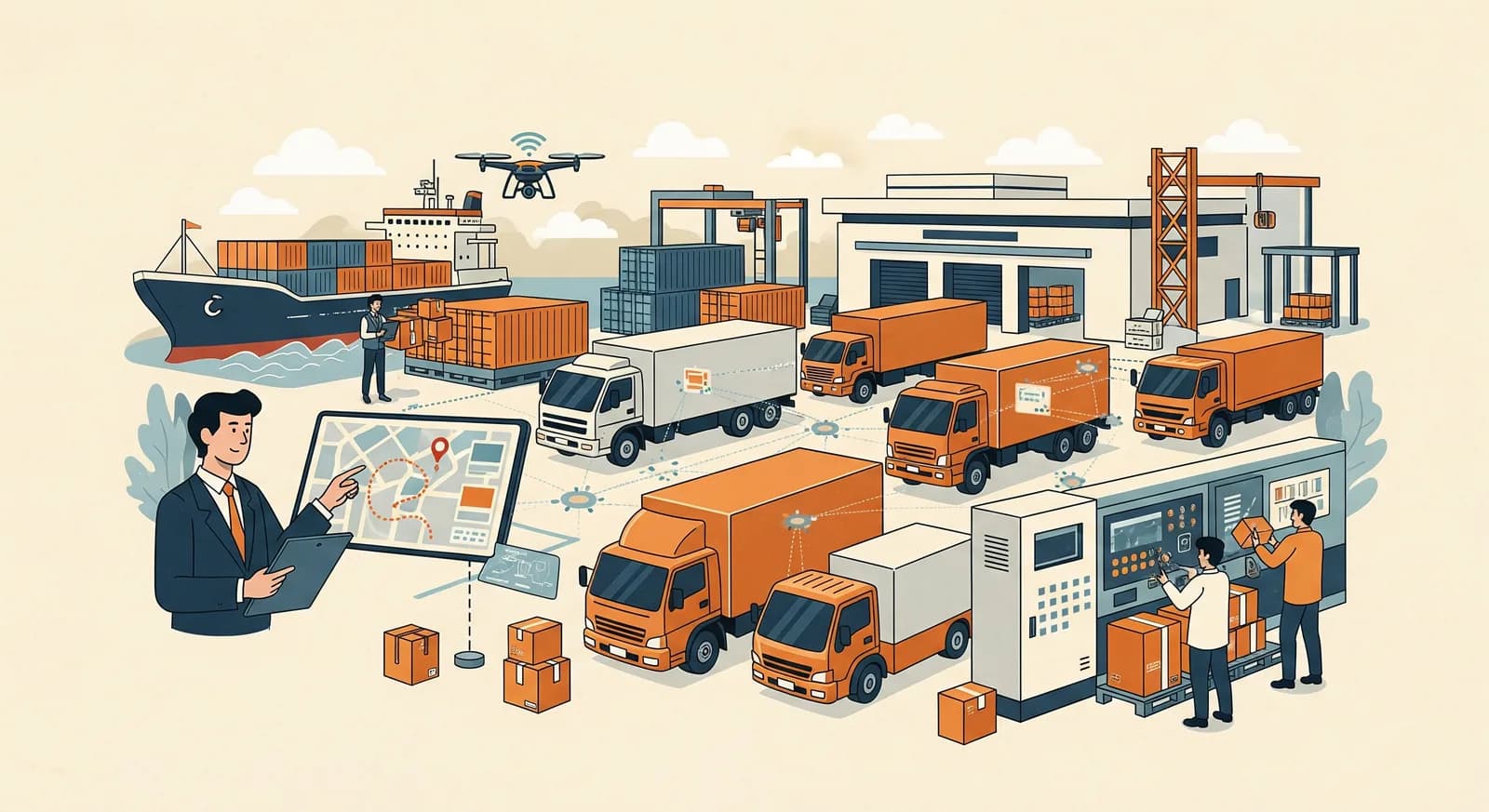
If you run a small transport or logistics firm, you've probably been pitched a "transport management system" that costs more per month than your second truck's insurance and promises to revolutionise your operation. Most of that software is built for fleets of two hundred vehicles, sold by people who have never spent a Friday afternoon trying to find out where a driver actually is. This is the other guide — the one for firms with five trucks, a dispatcher who is also the owner, and a whiteboard that still does most of the planning.
I've sat in enough haulage offices to know the rhythm of the place. The phone that won't stop. The driver who texts a photo of a delivery note instead of scanning it. The fuel receipts in a shoebox. The invoice that goes out four days late because nobody had time to chase the paperwork. None of this is a technology problem in the abstract — it's a time and visibility problem, and the right software fixes both. The wrong software just adds another login nobody opens.
So instead of ranking twenty products you'll never trial, let's do something more useful: work out which categories of software actually move the needle for a small transport business, what each one really does, and how to choose without getting talked into a platform built for someone ten times your size.
What transport software is actually meant to fix
Before you look at a single product, get clear on the four jobs software does in a transport firm. Almost every tool on the market is some combination of these, dressed up in different language. Knowing them lets you cut through the marketing fast.
- Knowing where your vehicles and loads are — without phoning the driver.
- Getting jobs from the inbox or phone onto a plan, and onto the right driver, with the least re-typing.
- Capturing proof that a delivery happened — signature, photo, timestamp — the moment it happens, not a week later.
- Turning all of that into an invoice and a clean set of records, quickly and without arguments.
Notice what's not on that list: fancy AI route optimisation across a national network, predictive maintenance dashboards, carbon analytics. Those are real things, and they matter at scale. For a five-to-twenty-vehicle operation they're usually a distraction from the four jobs above — the ones that, done badly, quietly cost you a day a week and a chunk of every invoice.
“You don't need a system that does everything. You need one that stops you re-typing the same delivery three times — that single fix pays for most software twice over.”
The categories that earn their keep
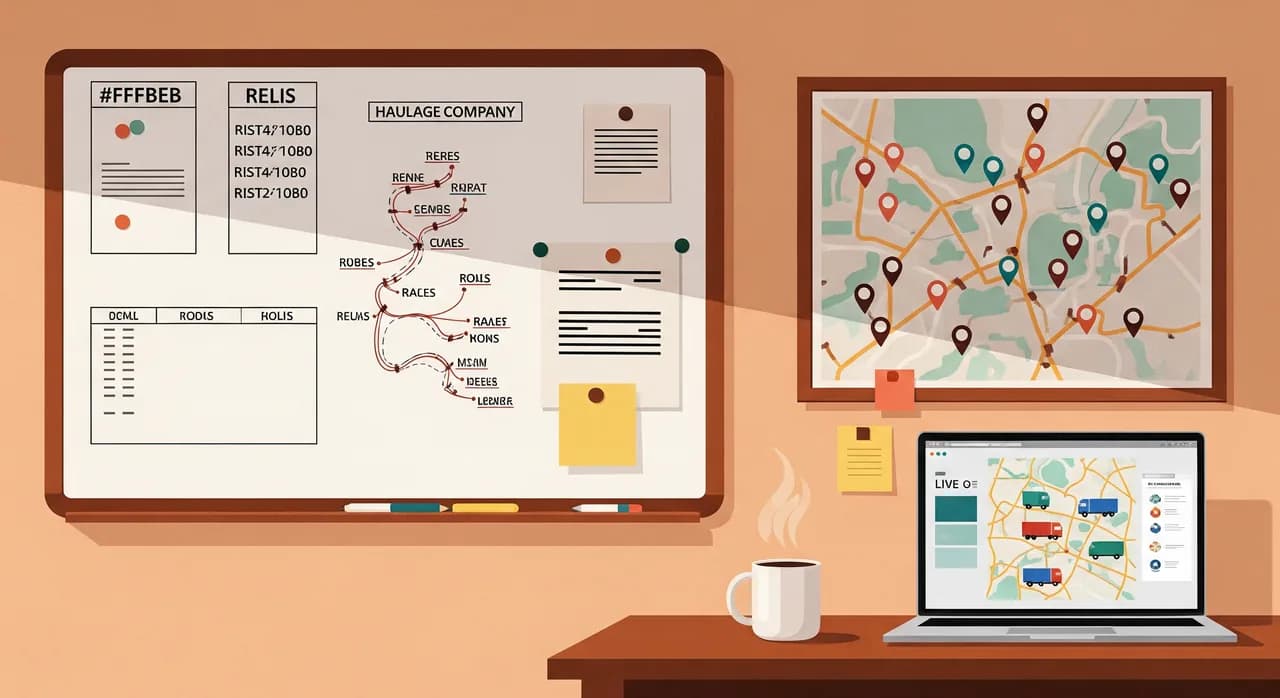
Here's how I'd group the software that's genuinely worth a small transport firm's attention, roughly in the order most firms should adopt it. You don't need all of it, and you certainly don't need it all at once.
Vehicle tracking and telematics
This is usually the first real win, because it removes the most expensive habit in the business: the dispatcher phoning round to ask where everyone is. A simple GPS tracking setup gives you a live map, basic geofencing (an automatic ping when a truck reaches a depot or customer), and a history you can show a customer who swears their delivery never came. The good news is this category is mature and cheap. Don't overbuy — you want reliable location and a clean map, not a cockpit of fifty metrics you'll never read.
Dispatch and job management
This is the heart of the operation: jobs come in, get assigned to drivers, and their status moves from planned to en route to delivered without anyone shouting across the office. For a small firm, a focused dispatch tool — or a well-built job board — beats a heavyweight transport management system every time. The thing to look for is how little re-typing it forces. If a job still has to be entered once for the driver, once for the invoice and once for the customer, the software hasn't solved your real problem.
Proof of delivery (the quiet money-maker)
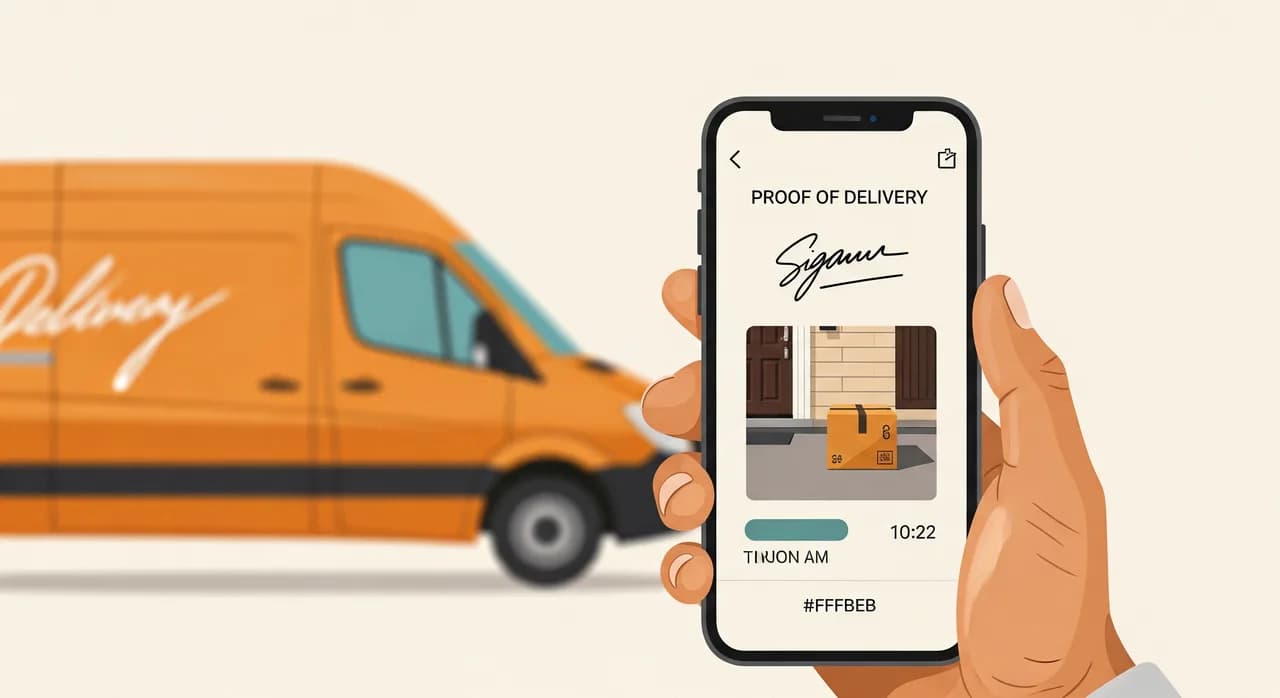
If you fix one thing this year, make it this. A proper proof-of-delivery app on the driver's phone captures a signature or a photo, stamps the time and location, and pushes it straight back to the office. No more paper notes lost in a footwell. No more invoices held up because the POD is "somewhere in the van." No more customer disputes you can't win because you've nothing to show. This single capability shortens your invoicing cycle and kills a whole category of arguments.
Route planning
Real route optimisation matters most when you've got many drops per vehicle per day — parcels, distribution, multi-stop service runs. If your work is mostly full loads point-to-point, fancy routing saves you less than the salesperson claims, and a good navigation app does most of the job. Be honest about your drop density before you pay for an optimisation engine; it's one of the most over-sold features in the whole sector.
Fuel, costs and compliance
Fuel is your second-biggest cost after wages, and it leaks through unrecorded receipts and guesswork. Software that pulls fuel-card data in automatically, tracks cost per vehicle and per job, and keeps an eye on service intervals and document expiry (insurance, inspections, driver licences) pays for itself by preventing one missed renewal or one untracked overspend. This is unglamorous and high-value — exactly the kind of thing that's easy to put off and expensive to ignore.
All-in-one suite or a few focused tools?
Every transport-software vendor eventually pitches you the dream of one platform that does it all — tracking, dispatch, POD, invoicing, fuel, the lot. It's a seductive idea, and for the right firm it's genuinely the right answer. But it's also the most common way small operators overspend and underuse.
The trade-off is real and worth thinking through honestly. An all-in-one suite means one login, one support number, and data that flows between modules without you wiring anything together. The cost is that you pay for the whole thing whether you use it or not, you're locked into their way of working, and switching later is painful. A handful of focused tools — a tracking app, a POD app, your existing accounting software — is cheaper to start, easier to swap piece by piece, but someone has to make them talk to each other.
| Your situation | Lean toward | Why |
|---|---|---|
| 1–5 vehicles, simple work | A few focused tools | Cheap, fast, low commitment |
| Growing fast, messy data | All-in-one suite | One source of truth beats five |
| Unusual workflow or niche | Focused tools + custom glue | Off-the-shelf won't fit you |
| Office staff already stretched | All-in-one or done-for-you | Fewer systems to maintain |
There's no universally right answer, only a right answer for your firm this year. My bias for small operators is to start focused and integrate the two or three tools that matter, rather than buy a suite you'll grow into "eventually." Eventually has a habit of never arriving while the subscription keeps charging.
How to choose without getting burned
Software demos are designed to dazzle. The vendor drives the tour, shows the polished happy path, and never opens the screen where your actual messy job lives. To choose well, you have to take the wheel. Here's the process I'd run before signing anything.
- 1Write down the one job it must doBefore any demo, write a single sentence: "This must let a driver capture proof of delivery and have it reach the office automatically." If a tool can't do that sentence cleanly, nothing else about it matters.
- 2Run your own ugliest job through the trialNot the demo job — yours. The multi-drop with a part-refusal and a damaged pallet. Software that handles your edge cases is software that will survive contact with your week.
- 3Put it on a real driver's phoneThe slickest office dashboard is worthless if the driver app is clumsy with cold hands in the rain. Test the part your least patient driver will actually use. Their verdict decides it.
- 4Check what leaving costsAsk, in writing, how you export your data and what happens to your history if you cancel. A vendor who makes leaving easy is usually confident you'll stay.
- 5Count the real monthly costPer-vehicle fees, per-user fees, hardware, the setup charge, the "premium" tier that holds the one feature you need. Add it up across a year before you compare prices.
A small case study: five trucks, four days late on every invoice
Let me make this concrete with a firm we worked with — anonymised, but the shape of it is typical. A regional haulier, five trucks, two office staff, doing a mix of full loads and some multi-drop for a couple of regular customers. Profitable, busy, and quietly drowning in admin. The owner's actual complaint when he called wasn't "I need software." It was: "I'm always the last thing in the day, and the invoices go out late."
When we walked the week with him, the bottleneck was obvious and it wasn't planning — it was paper. Drivers handed in delivery notes at the end of a shift, sometimes the next morning, sometimes crumpled and unreadable. The office couldn't invoice until the note was in hand and matched to the job. So every invoice ran roughly four days behind the actual delivery, cash came in slow, and two or three disputes a month dragged on because nobody could prove exactly when and where a drop happened.
What we changed
We resisted the urge to rebuild everything. No grand transport-management platform. We did three small things. First, a proof-of-delivery app on the drivers' phones — signature or photo, captured at the door, synced instantly. Second, we connected that capture to the job record so a completed delivery flagged itself as ready to invoice automatically. Third, we left their accounting software exactly where it was and simply fed it clean, complete job data instead of a shoebox.
Deliberately, we left the dispatch whiteboard alone. The owner liked it, his staff trusted it, and it wasn't the source of the pain. Replacing things that already work is how you turn a two-week win into a six-month fight. We changed the one thing that was costing him money and left the rest.
The result, a couple of months in: invoices that used to lag four days now went out same-day or next-day, because the proof was already in the system the moment the truck pulled away. Cash came in noticeably faster. The disputes mostly evaporated — when a customer queried a drop, the office pulled up a time-stamped photo in seconds. The numbers here are illustrative rather than audited, but the direction is exactly what you'd expect: one well-chosen fix, not a platform, did almost all the work.
“He didn't need a transport management system. He needed to stop waiting on paper. The smallest change closed his biggest gap.”
Where AI fits — and where it's just a sticker
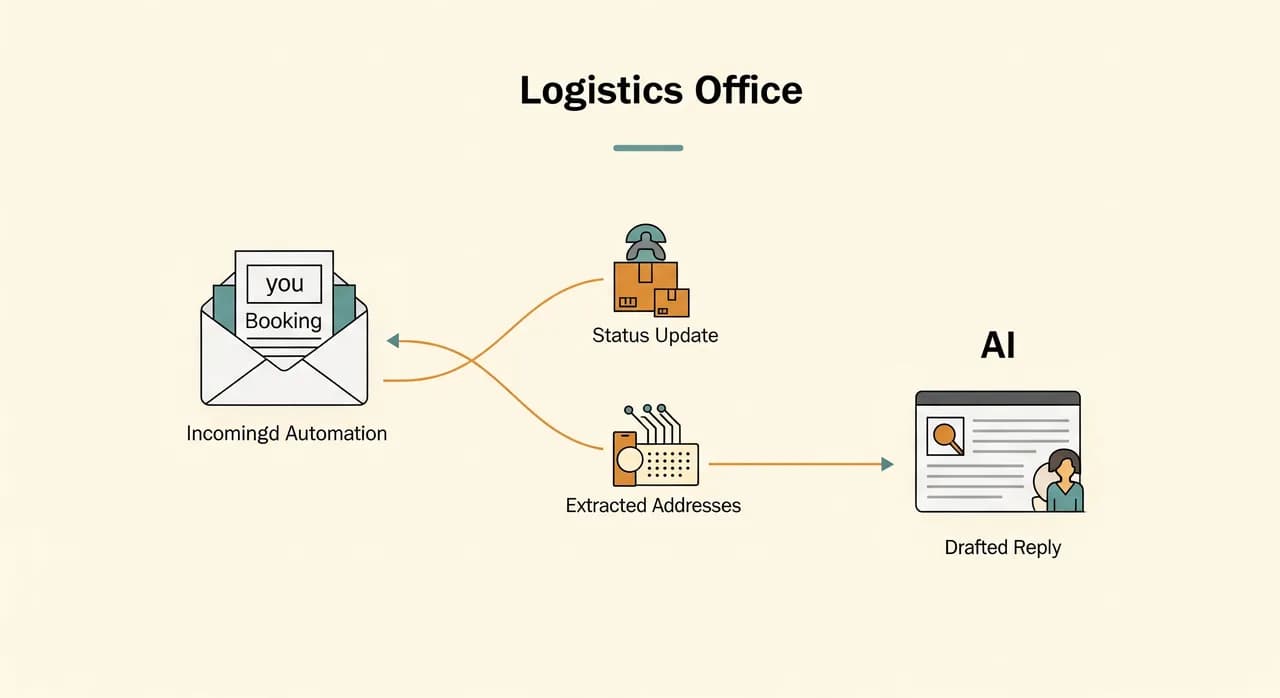
Transport software is busy slapping "AI" on everything right now, so it's worth being clear-eyed. A reminder that fires when a vehicle inspection is due isn't AI — it's a date and a rule, and that's fine, it still saves you. Real AI earns its keep on the messy, language-shaped jobs: reading a free-text booking email and pulling out the addresses and dates, drafting a first-pass reply to a customer chasing a delivery, fielding the same routine phone questions so your dispatcher isn't interrupted mid-plan.
The method, in one paragraph
If you take nothing else from this: don't buy a platform, fix a problem. Find the moment in your week that makes you swear — usually "where is he?" or "where's that delivery note?" — and solve that one thing with the smallest tool that does it cleanly. Trial it with your ugliest real job and your least patient driver. When it's working and trusted, pick the next sore spot and do it again. Four small, finished fixes in a year beat one giant system you're still configuring at Christmas.
Not sure which tool fits your firm?
We'll walk your week with you — the loads, the paperwork, the late invoices — and point at the one fix worth doing first. No platform pitch, no obligation to build anything.
See how we help transport firmsCommon questions
What's the best software for a small transport company?
Do I need a full transport management system (TMS)?
Is route optimisation software worth it?
Will my drivers actually use it?
Should I replace my accounting software too?

Have a nice day is a software studio that helps small and mid-sized businesses go digital — automation, AI and custom software that works in everyday operations, not just on slides.