When Does an AI Agent Actually Make Sense for Your Business?
"Agent" is the word of the year, and most of what's sold under it is a chatbot with ambition. Here's a calm, practical look at when an AI agent earns its keep in a small business — and the far more common cases where it doesn't.
 Have a nice day14 min read
"Agent" has become the word every software vendor reaches for, the way "AI-powered" was two years ago and "cloud" was a decade before that. Half the time it means something genuinely new and useful. The other half it's a chatbot with a press release. If you run a small business and you're trying to work out whether you need one of these things, the noise is not helping you. So let's strip the word back to what it actually means, and ask the only question that matters: would this save you real time, or just sound impressive at a conference?
I spend a lot of my week with owners of small and mid-sized businesses who've read a breathless article about autonomous AI and arrived convinced they're behind. They're rarely behind. More often they're about to spend money and attention on something far heavier than the problem in front of them. An agent is a powerful tool — but like any powerful tool, most of the time you reach for it you'd have been better off with a screwdriver.
This is the guide I give those people. It explains, in plain terms, what an AI agent really is, the handful of situations where it's genuinely the right answer, the much larger set of situations where it isn't, and how to find out cheaply before you commit. No hype, no acronyms you have to memorise, and no pretending the technology is further along than it is.
What an AI agent actually is (and isn't)
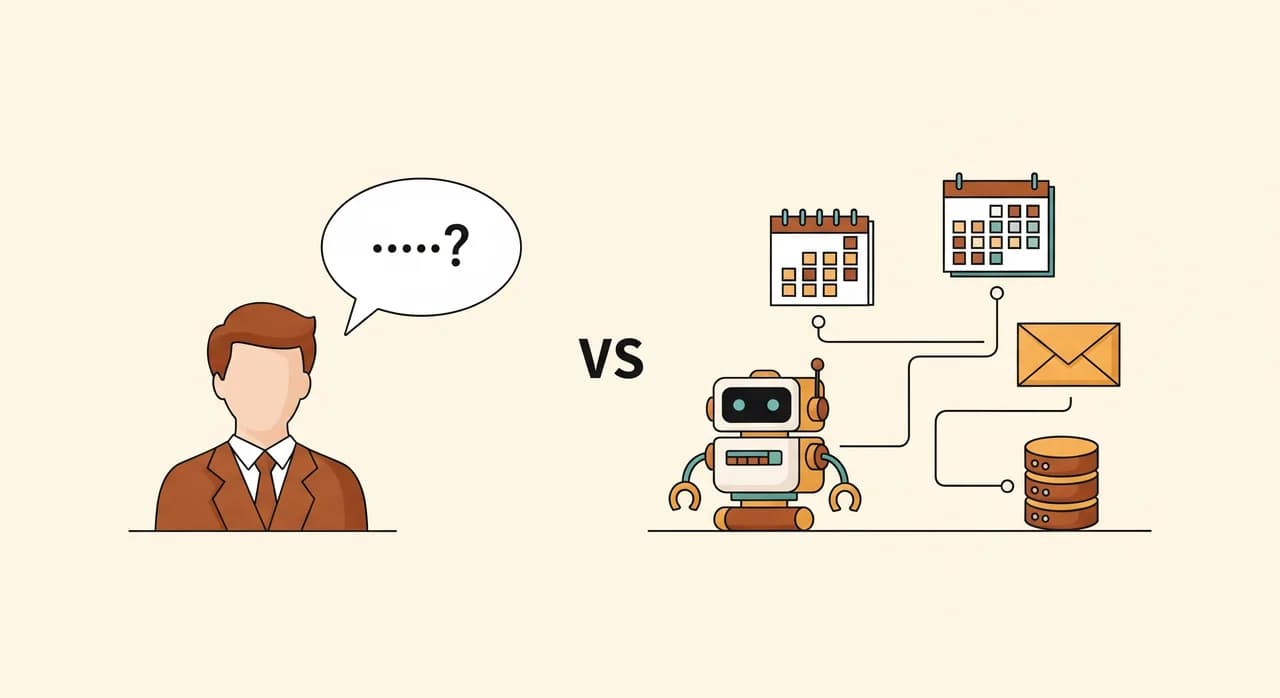
Let's get the definition straight, because the marketing has blurred it badly. A plain chatbot answers a question and stops. You ask, it replies, the conversation ends. An AI agent is different in one specific way: it can take a goal, break it into steps, and act across several tools to get there — checking a calendar, sending an email, updating a record, looking something up — and then deciding what to do next based on what it found. It doesn't just talk. It does things, in a loop, until the job is finished or it gets stuck.
That word act is the whole distinction. A chatbot that drafts a reply is answering. An agent that reads an incoming booking request, checks availability, books the slot, sends the confirmation, and adds the customer to your CRM — that's an agent, because it strung together several actions toward a goal without you steering each one. The capability is real. The question is never whether it's impressive. It's whether your problem actually needs that many steps strung together.
Why everything is suddenly called an agent
It helps to understand why the word is everywhere, because once you see the incentive you'll stop being swayed by it. "Agent" sells. It implies autonomy, intelligence, a digital employee you can hire for a fraction of a salary. That's an irresistible pitch, so every tool that can send an email now describes itself as agentic, whether or not it makes a single independent decision.
The result is a market where the label tells you almost nothing. A genuinely autonomous system that handles your entire intake process and a glorified auto-reply both wear the same badge. So when someone offers you "an AI agent," the useful response isn't yes or no — it's "show me the steps it takes on its own, and show me what happens when one of them fails." The good ones have a clear answer. The costume ones change the subject.
“Don't ask whether it's an agent. Ask how many steps it takes without you — and what it does when one of those steps goes wrong.”
When an AI agent genuinely makes sense
Let's be fair to the technology, because there are real cases where an agent is exactly right and nothing simpler will do. They share a recognisable shape. The task is multi-step — it touches several systems, not one. It involves some judgement on messy, human input, so a rigid rule can't cover every branch. It happens often enough that the setup pays back. And crucially, a mistake is recoverable — you can catch and fix it without serious harm.
When all four of those line up, an agent stops being a gimmick and starts being a quiet, tireless junior teammate. Here are the patterns I actually see working in small businesses:
- End-to-end booking and rescheduling — reading a free-text request ("can we move Thursday to next week, ideally morning?"), checking the calendar, proposing a slot, confirming, and updating every system involved.
- Lead intake and qualification — taking a message from a form, email or chat, asking the two or three follow-up questions a human would, and either booking the right next step or routing it to the right person with a tidy summary.
- Order and document triage — pulling structured details out of inconsistent supplier emails or PDFs, deciding which go straight through and which need a human, and queuing the exceptions with a note.
- First-line support that resolves, not just deflects — handling the routine "where's my order / how do I change my booking" questions by actually looking up the answer and taking the action, then handing the genuinely tricky ones to a person.
- Recurring research-and-summarise jobs — gathering the same scattered information every week, checking a few sources, and producing the report a person used to assemble by hand.
Notice what these have in common. None of them is "replace a human." Each one is "take a specific, repetitive, multi-step chore off a human's plate so they can do the part that actually needs them." That's the honest promise of an agent in a small business — not a robot workforce, a handful of finished chores.
When it absolutely doesn't — and a rule wins
Now the part the vendors skip. The majority of tasks people want to hand an agent would be better served by something far simpler — and simpler means cheaper, faster, and dramatically more reliable. An agent that decides what to do can also decide wrong. A rule that always does the same thing never surprises you at 2am.
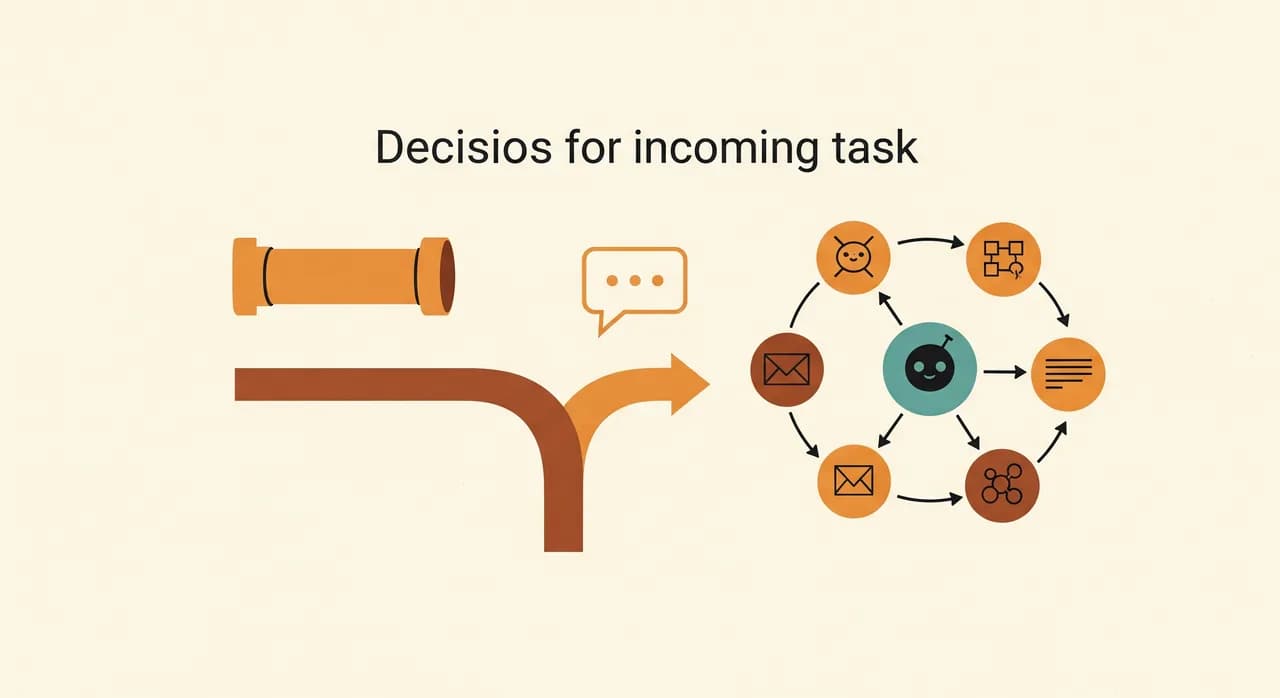
If a task follows fixed steps every single time, you don't want intelligence, you want a pipe. "When an order comes in, create the invoice" is a rule. "Two hours before an appointment, send a reminder" is a rule. Wrapping those in an agent doesn't make them better — it adds cost, latency and a small chance of creative misbehaviour to a job that was already solved. Use the boring tool. Boring is a feature.
There's also a maintenance truth nobody mentions in the demo. An agent is not something you switch on and forget. It needs guardrails, monitoring, and someone who notices when it starts confidently doing the wrong thing. Every agent you deploy is a small ongoing responsibility. Two well-chosen ones your team trusts beat ten clever ones nobody's watching.
A four-question checklist before you commit
You don't need a consultant to make this call. Run any candidate task through four questions, and the answer usually becomes obvious. If you can't say yes to all four, you almost certainly don't want an agent — you want something simpler, or you're not ready yet.
- 1Is it genuinely multi-step?Does the task touch several tools or require a chain of decisions? If it's one action with one outcome, a rule or a chatbot wins. Agents earn their cost in the linking-together.
- 2Is the input messy and human?Free-text emails, varied phrasing, inconsistent documents — that's where judgement is needed and a rigid rule breaks. If every input looks identical, you don't need intelligence.
- 3Does it happen often enough to pay back?Setup and upkeep are real. A task that runs many times a week justifies the effort; one that runs twice a year almost never does.
- 4Is a mistake recoverable?If the agent gets it wrong, can a human catch and fix it cheaply? If a wrong move spends money or damages a relationship, keep a person in the loop — or don't automate it at all yet.
| Task | Right tool | Why |
|---|---|---|
| Send appointment reminder | Rule | Same steps every time, no judgement needed |
| Answer 'what are your opening hours?' | Chatbot | One question, one answer |
| Book, reschedule and confirm across systems | Agent | Multi-step, messy input, real decisions |
| Create invoice from a new order | Rule | Fixed pipe between two systems |
| Qualify a lead and route it | Agent | Needs follow-up questions and judgement |
| Approve a large payment | Human (+ tools) | Mistake is expensive and hard to undo |
A short, real-shaped example
To make this concrete, here's a composite of a job we see often — details blurred, but the shape is true to life. A regional services company with around fifteen staff was drowning in inbound enquiries. Every form submission, email and missed-call voicemail landed in a shared inbox, and a part-time coordinator spent most of her mornings reading each one, working out what it was, asking for the missing details, and forwarding it to the right person. Good enquiries went cold simply because nobody got to them before lunch.
Their first instinct, fresh from an article much like this one, was "we need an AI agent to handle everything." We pushed back. About half the volume was the same handful of routine questions — pricing, availability, where they covered — and those didn't need an agent at all; a simple chatbot on the site answered them instantly. That alone cut the morning pile by a meaningful chunk.
The remaining traffic was the genuinely agent-shaped part: real enquiries that needed reading, a clarifying question or two, and routing to the right person with a clean summary. So we built one narrow agent for exactly that — not "handle everything," just intake-and-route. It read each new enquiry, asked the one or two follow-ups a human would, attached a tidy summary, and dropped it in front of the right team member, flagging anything unusual for the coordinator instead of guessing.
The result wasn't science fiction, and that's the point. The coordinator stopped spending mornings sorting and started spending them on the enquiries that needed a human touch. Response times on new leads dropped from "sometime that day" to minutes. Nobody lost a job. The lesson the owner took away — and the one worth taking from this whole article — is that the win came from splitting the work into the part that needed a rule, the part that needed a chatbot, and the small, well-defined part that truly needed an agent. The mistake would have been handing all three to one expensive, over-ambitious system.
How to start without betting the business
If you've run the checklist and a task genuinely fits, the way you start matters as much as what you build. Treat it like a small, reversible experiment, not a launch. The goal of the first attempt isn't a finished system — it's proof that this particular agent earns its keep before you wire it deeper into your day.
- 1Pick one narrow taskNot your messiest, most ambitious dream. The single multi-step chore that passed all four questions cleanly. Write one sentence describing what 'done' looks like.
- 2Keep a human in the loop at firstLet the agent prepare and propose, while a person approves before anything goes out or changes. You learn where it stumbles without any real risk.
- 3Watch it for a couple of weeksRun it alongside the old way. Collect the cases it gets wrong — they're gold. They tell you exactly where to tighten the guardrails.
- 4Loosen the leash only once you trust itWhen it's quietly right week after week, let it act on its own for the safe, routine cases — and keep the human checkpoint for the rare, risky ones. That blend is where most small businesses should settle.
That's the entire method. Narrow target, human in the loop, watch, then loosen — never the reverse. Done this way, an agent stops being a leap of faith and becomes what it should be: a small, finished improvement you can actually feel, that you chose deliberately because the task genuinely needed it.
Not sure if your task really needs an agent?
That's the most useful question to get right before you spend a cent. We'll look at the specific task with you and tell you honestly whether it wants an agent, a chatbot, or just a simple rule — no obligation to build anything.
See how we approach AI agentsCommon questions
What's the real difference between an AI agent and a chatbot?
Is an AI agent worth it for a small business?
Will an AI agent replace my staff?
How much does an AI agent cost to set up?
Is it safe to let an AI agent act on its own?

Have a nice day is a software studio that helps small and mid-sized businesses go digital — automation, AI and custom software that works in everyday operations, not just on slides.