How a Three-Therapist Physio Practice Tamed Its Booking Chaos
A small physiotherapy practice was losing whole afternoons to the phone and a chunk of its revenue to no-shows. Here is exactly what we changed, what it cost in effort, and what actually moved the numbers.
 Have a nice day13 min read
The owner of a small physiotherapy practice put it to me bluntly in our first call: "My receptionist spends more time on the phone than with patients, and I still lose two or three slots a day to people who just don't show." That sentence is the whole case study in a nutshell. What follows is what we actually did about it — anonymised, but real — including the parts that didn't go to plan.
I want to be honest up front about what this is and isn't. It isn't a glossy success story where a single tool fixed everything overnight. It's a practical account of a three-therapist practice that was drowning in admin, the changes we made over about six weeks, and the difference those changes made to a calendar and a bank account. The numbers in here are illustrative — rounded, anonymised, true to the shape of what we saw rather than a sworn audit. The lessons, though, are exactly what we took away.
If you run a clinic, a studio, or any business where the calendar is the business, you'll recognise most of this. The specifics are physiotherapy. The pattern is universal.
The situation: a good practice strangled by its own front desk
The practice was doing well clinically. Three therapists, a loyal patient base, a waiting list for certain treatments. By every measure that should matter, it was healthy. And yet the owner was stressed, the front desk was frazzled, and the schedule was full of holes that shouldn't have been there.
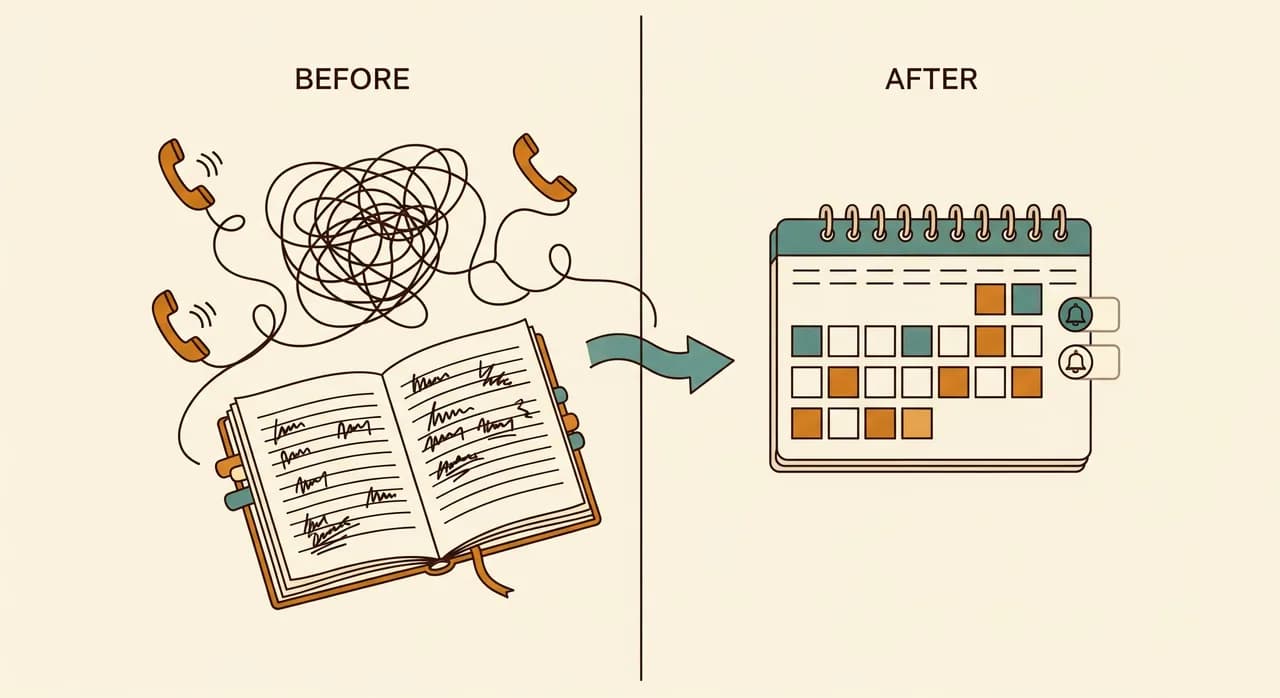
The booking process was entirely manual and entirely human. Patients called during opening hours — which meant the phone rang constantly, often while the receptionist was checking someone in or a therapist was mid-session and had to break concentration to answer. Appointments lived in a paper diary and a shared calendar that didn't always agree with each other. Reminders, when they happened, were a phone call the receptionist made if she had time, which on a busy day she didn't.
The two symptoms the owner felt most were the ones that cost the most. First, the phone tax: hours of every day spent playing telephone tennis with people trying to book, reschedule, or ask whether they had an appointment at all. Second, the no-shows: somewhere between two and four empty slots a day where a patient simply didn't turn up, each one an hour of a therapist's time billed to nobody.
“A no-show in a physio practice isn't a minor annoyance. It's a billable hour that vanishes and can never be sold again.”
We spent the first session not selling anything, but counting. We asked the receptionist to keep a simple tally for one week: every inbound call, what it was about, and roughly how long it took. We also pulled four weeks of the diary and marked every no-show and late cancellation. You can't fix what you haven't measured, and the owner's gut estimate — like almost everyone's — turned out to be off in interesting ways.

What the week of counting actually revealed
The tally surprised everyone, including me. The owner assumed the biggest time-sink was new patients booking first appointments. It wasn't. The single largest category of calls was existing patients rescheduling — moving an appointment by a day or two. The second largest was people simply asking, "When is my next appointment?" Neither of those needs a human being. Both were eating the front desk alive.
- Roughly 4 out of every 10 calls were reschedules or 'confirm my time' queries — pure admin a patient could do themselves.
- New-patient bookings, the calls that actually needed a careful human conversation, were a minority of the volume.
- No-shows and last-minute cancellations clustered heavily on Monday mornings and the day after a public holiday.
- Almost no appointments had received a reminder, because reminding was a manual task that lost every fight for the receptionist's attention.
That reframing changed the whole project. We weren't there to replace the receptionist with software. We were there to take the dull, repetitive 40% off her plate so she could spend her attention on the patients in front of her and the calls that genuinely needed a person. And we were there to make reminders happen automatically, every single time, regardless of how busy the day got.
What we changed, in plain terms
We deliberately kept the scope small. The temptation in a project like this is to rebuild everything — new practice-management suite, new patient records, new billing, the lot. That's how a six-week win turns into a six-month migration that everyone comes to resent. We didn't touch the clinical records. We changed three specific things, and nothing else.
1. Online self-service booking
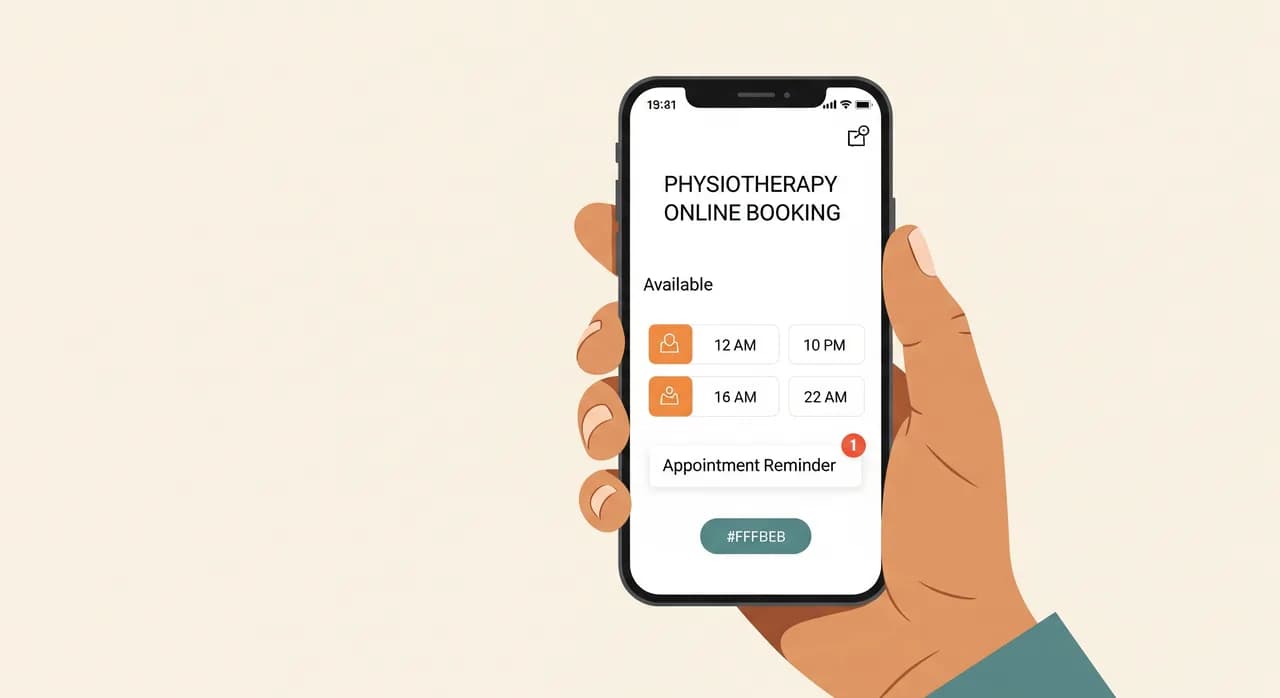
We set up an online booking page where patients could see real availability and book, reschedule, or cancel themselves — 24 hours a day, not just when the phone was staffed. The booking rules mirrored how the practice actually worked: different appointment lengths per treatment type, buffers between sessions, each therapist's own hours, and blocks for the times therapists shouldn't be booked back-to-back. The link went on the website, in the email signature, and on a little card handed out at the end of each session.
2. Automatic reminders that actually fire
Every booking now triggers an automatic confirmation, then a reminder by SMS and email a fixed time before the appointment — with a one-tap link to confirm, reschedule, or cancel. This is the boring rule-with-a-clock kind of automation, and it's the part that moved the no-show number the most. Crucially, the reminder gives the patient an easy way to free the slot if they can't make it, which means a cancellation often turns into an opening someone on the waiting list can grab.
3. One calendar everyone trusts
The paper diary and the shared calendar were merged into a single source of truth that updates in real time as patients book. No more double-bookings because two systems disagreed. The receptionist still sees and controls everything — she can override, block, and book on a patient's behalf — but she's no longer the only way an appointment can enter the system.
- 1Week 1 — Map and countShadowed the front desk, tallied a week of calls, and pulled four weeks of no-show data. Defined exactly what 'done' looked like before touching any tool.
- 2Week 2 — Configure the booking rulesSet up appointment types, durations, buffers, and each therapist's hours so the online calendar matched reality, not a generic template.
- 3Week 3 — Wire up confirmations and remindersBuilt the automatic confirmation and the SMS-plus-email reminder with one-tap reschedule and cancel links.
- 4Week 4 — Run parallelKept the paper diary alive alongside the new system for a week, catching edge cases — a therapist's recurring blocked hour, a treatment type we'd missed — with zero risk.
- 5Weeks 5–6 — Switch over and coach patientsRetired the paper diary, trained the front desk on overrides, and started actively pointing patients to the booking link at the end of each visit.
The rollout: where it nearly went sideways
It would be dishonest to pretend this was frictionless. Two things nearly tripped us up, and they're worth more than any success metric because you'll likely hit them too.
The first was the receptionist's understandable fear that this was about replacing her. It wasn't, and the data made that obvious — but you can't argue someone out of a worry like that with a spreadsheet. What worked was framing the change as taking the tedious part of her job away, not the job. Within two weeks she was the system's biggest advocate, because she felt the difference on a Monday morning. The phone stopped being a fire hose.
The second was an older slice of the patient base who genuinely preferred to phone. We never tried to force them online. The phone stayed open, staffed, and welcome. The point was never to eliminate calls — it was to remove the calls that didn't need a human, so the ones that did could be answered properly. Online booking is an addition to how people reach you, not a wall in front of it.
The results, with honest caveats
Here's what happened over the three months after switch-over, compared with the four weeks of baseline data we'd captured at the start. I'll give the numbers and then immediately tell you why you should treat them as a direction of travel, not a guarantee.
| Measure | Before | After | What changed |
|---|---|---|---|
| No-show rate | ~14% of appointments | ~5% | Automatic reminders with one-tap reschedule |
| Front-desk phone time | Several hours/day | Roughly halved | Self-service reschedules and confirmations |
| After-hours bookings | 0 (phone only) | About a quarter of all bookings | 24/7 online booking page |
| Filled cancellations | Rare | Common | Freed slots offered to the waiting list quickly |
The no-show drop was the headline, and it's the one with the clearest cause: a reminder that lands reliably, with an effortless way to cancel, turns a forgotten appointment into a freed slot. Cutting no-shows from roughly one in seven to one in twenty, in a practice running three therapists full days, is not a rounding error — it's a meaningful number of billable hours recovered every week without seeing a single extra patient per slot.
“We didn't add a single hour to anyone's week. We just stopped losing the hours that were already paid for.”
The honest caveats: every practice is different, and your no-show rate depends on your patient mix, your treatments, and your local norms as much as on any tool. A practice starting from a 6% no-show rate won't see the same swing as one starting from 14%. And the after-hours booking share will depend entirely on how consistently you point patients to the link. The mechanism is reliable; the exact magnitude is yours to discover.
Why this worked when so many tool rollouts don't
Plenty of clinics buy booking software and still feel no better off a year later. The difference here wasn't the tool — booking tools are broadly capable these days. The difference was the approach, and it comes down to a few decisions.
We measured before we changed, so we automated the thing that was actually costing money rather than the thing the owner assumed was. We kept the scope brutally small — three changes, no clinical-records migration, nothing we couldn't finish in six weeks. We ran in parallel so the switch-over carried no risk. And we treated the front desk as the project's ally, not its target, which is the difference between staff who quietly sabotage a new system and staff who champion it.
Run a clinic with the same booking pain?
If your front desk is buried in the phone and your calendar has holes it shouldn't, the first step is just an honest look at where the time and the no-shows actually go. We'll walk through it with you — no obligation to build anything.
See how we set up physio bookingCommon questions
Will online booking replace my receptionist?
What if some of my patients don't want to book online?
How much of the no-show drop is really down to reminders?
How long did the whole thing take to set up?
Are these results guaranteed for my practice?

Have a nice day is a software studio that helps small and mid-sized businesses go digital — automation, AI and custom software that works in everyday operations, not just on slides.