From Idea to First Paying Users: How We Launched a B2B SaaS
A founder came to us with a spreadsheet, a hunch, and a deadline. Eleven weeks later there were paying customers. This is the honest, anonymized story of what we built, what we deliberately left out, and where we got it wrong.
 Have a nice day14 min read
She arrived with a spreadsheet, a hunch, and a deadline her industry conference had set for her without asking. In four months she would be on a small stage in front of roughly two hundred people who ran the exact kind of business her idea was meant to serve. She wanted something real to show them — not slides, not a mockup, but a product a stranger could log into and pay for. That conversation is where this case study starts, and the most useful thing about it is how ordinary the starting point was.
We've changed the identifying details here on purpose. The founder is real, the product is live, and the numbers are close to the truth but rounded and softened so nobody can reverse-engineer who this is. What matters isn't the specific niche — it's the shape of the journey, because that shape repeats almost every time a non-technical founder tries to turn a good idea into working software. If you're somewhere near the beginning of that road, this is roughly what the next few months can look like when it goes well.
The short version: an industry she knew intimately, a painful manual process everyone in it tolerated, a spreadsheet she'd been quietly using to do it better than her peers, and zero technical background. Eleven weeks of focused work later, the first paying users were in. Here's how, and — more honestly — here's where we stumbled.
The situation: a spreadsheet doing a real job
The founder ran a small consultancy in a regulated, document-heavy field. Her clients were other small businesses, and every one of them wrestled with the same recurring chore — gathering a stack of forms, checking them for completeness, chasing the missing bits, and producing a clean summary before a deadline. Most of her competitors did this with email, phone calls, and a folder of Word templates. She did it with a spreadsheet she'd built and refined over four years, and her clients quietly loved her for it.
That spreadsheet was the whole insight. It wasn't a business plan or a market analysis — it was evidence. People were already relying on her tool, asking her to run it for businesses she didn't even consult for, offering to pay just for access. When customers try to buy something before you've built it, you can stop guessing whether there's demand. The question was never is this worth doing. The question was can this become software someone else can use without her sitting next to them.
“When customers try to pay you for a spreadsheet, you don't have an idea anymore — you have a product that hasn't been built yet.”
Her constraints were just as real. A fixed budget that came out of her own savings, not a fund. The conference deadline. And a hard rule we agreed on early: this could not become a project that demanded her attention every day, because she still had a consultancy to run. Whatever we built had to be finishable, affordable, and boring to operate. Those three words shaped every decision that followed.
The first job was deciding what NOT to build
When founders describe their dream product, the feature list is always enormous, because they've been imagining it for years. Hers filled two pages: dashboards, team permissions, an audit trail, automated reminders, a client-facing portal, billing, analytics, integrations with three tools her clients used, and — of course — "some AI in there somewhere." Every item was reasonable. Building all of them before launch would have been a disaster.
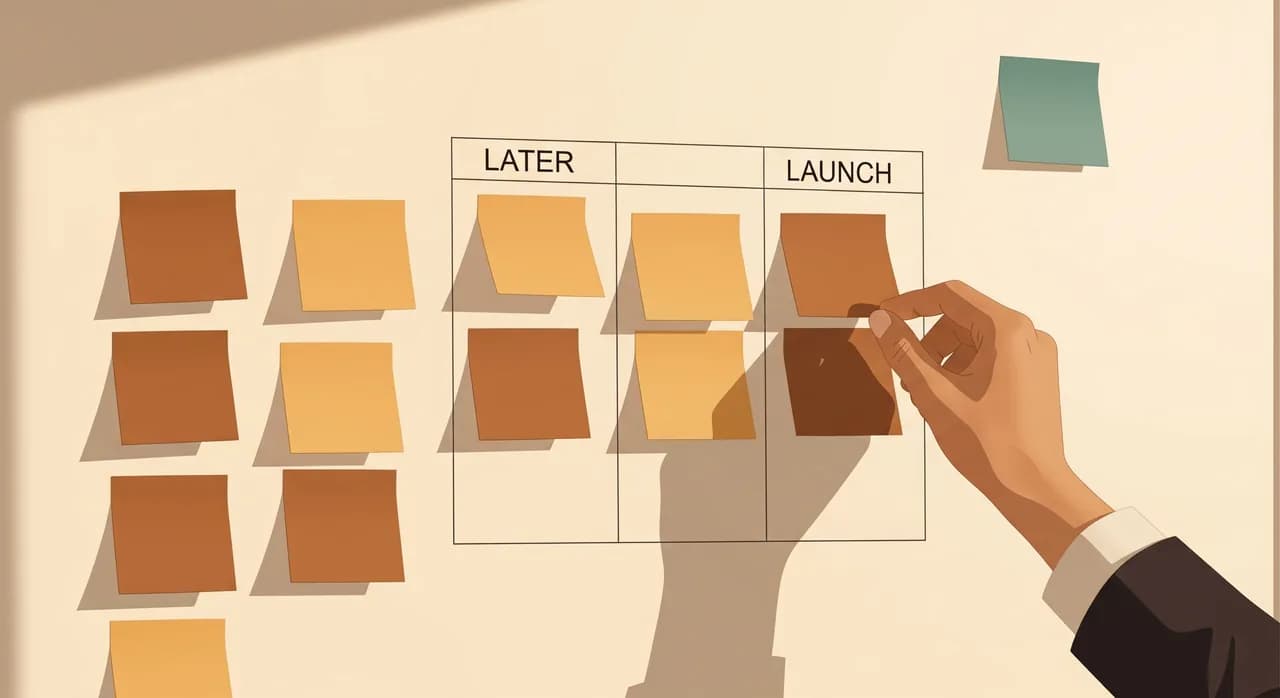
So we ran the exercise we run with everyone: for each feature, we asked a single blunt question. If this were missing on launch day, would a customer refuse to pay? Not "would it be nicer with it" — would the sale actually die. Most features fail that test, and that's the point. The ones that survive are your real product. Everything else is a roadmap, which is a lovely thing to have, but not the thing you build first.
What survived was almost embarrassingly small. A user could create an account, set up a case, invite their client to upload the required documents, and get back the same clean, checked summary her spreadsheet produced — except automatically, and without her in the loop. That was it. No dashboards. No team roles. No AI, not yet. Four features, one clear job, done properly.
What we actually built in eleven weeks
We work in short, visible cycles rather than disappearing for three months and returning with a surprise. Every week or so the founder got a link to something she could click, even when it was ugly and half-wired. That rhythm matters more than it sounds: it kept her decisions small and frequent instead of letting them pile up into one terrifying review at the end.
Weeks 1–3: the spine
First we built the unglamorous core — accounts, a secure way to store documents, and the data model underneath the case workflow. None of this is visible to a customer, and all of it is the part that's expensive to fix later if you rush it. Because the product handled other businesses' sensitive paperwork, we treated access control and data separation as a launch requirement, not a later upgrade. That's one of the few places we refused to cut.
Weeks 4–7: the actual job
Then the part that made it worth paying for: turning her spreadsheet logic into the engine that checks documents for completeness and produces the summary. This was the heart of the product and we gave it the most time. We sat with her and pulled apart why each rule in her spreadsheet existed — and several of them turned out to be habits rather than requirements, which let us simplify. By the end of week seven, you could run a real case start to finish.
Weeks 8–11: making it safe to charge for
The last stretch was the difference between a demo and a product. Payment, so people could actually subscribe. A clean signup that didn't need a manual. The dozen small error states that decide whether a stranger trusts your software or bounces. And testing — boring, repetitive testing — with the founder and two friendly clients who agreed to break it on purpose before strangers did. That last group earned their early-access discount many times over.
The 'put some AI in it' question, answered honestly
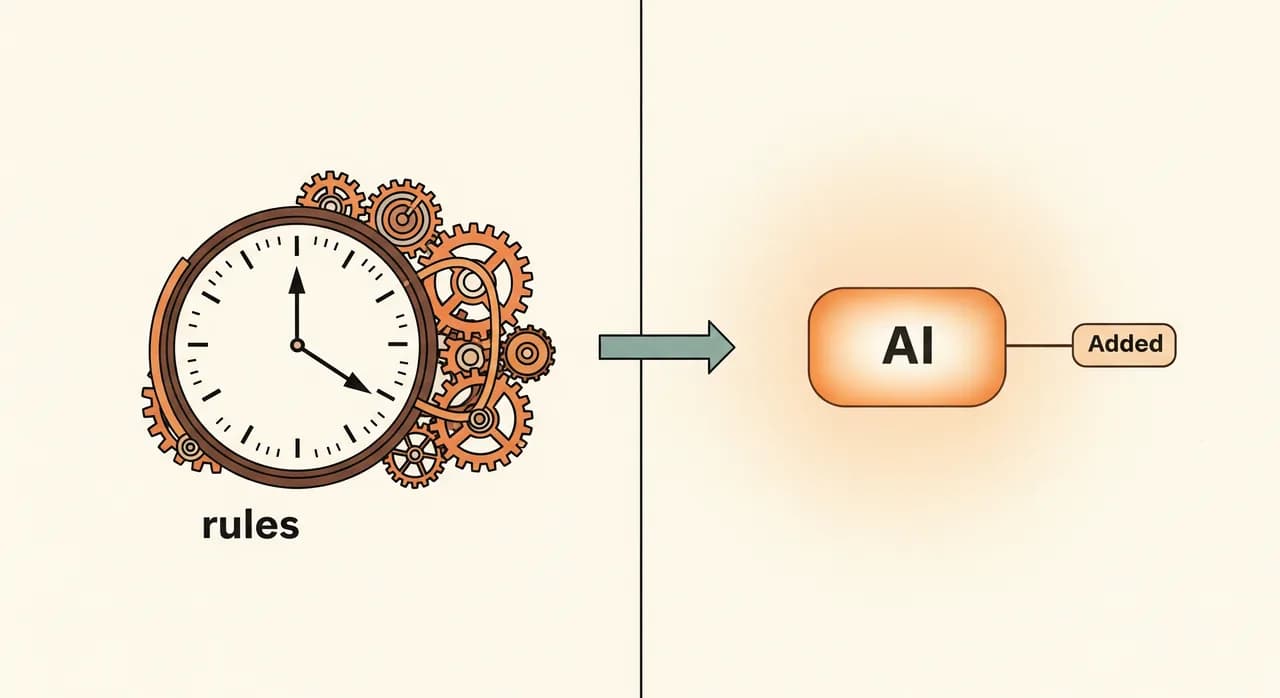
Her wishlist had AI on it, the way most wishlists now do. We pushed back, and it's worth explaining why, because it's the same advice we give almost everyone. The job version one needed to do — checking a known set of documents against a known set of rules — is a job that rules do better than AI does. It's predictable, it's auditable, and when a regulated client asks "why did the system flag this," you want a clear answer, not a shrug.
That doesn't mean AI had no place. There was a genuinely messy, language-shaped problem hiding in the workflow: clients often uploaded documents that were almost right but labelled wrong, or pasted information as free text instead of filling the form. Reading that mess and sorting it is exactly what modern AI is good at. So we noted it carefully — and then we left it for version two. Adding it before launch would have delayed the deadline to polish a feature nobody had yet asked to pay for.
Getting the first paying users
Here's the part founders worry about most and prepare for least. A product nobody can find isn't a business, it's a hobby. But this founder had an advantage worth more than any marketing budget: she already had an audience who trusted her, and a few of them had been asking to pay before the software existed. The launch plan leaned entirely on that, and so should yours if you have it.
Rather than a splashy public launch, we did the opposite — a quiet, deliberate one. Two weeks before the conference, she emailed the handful of clients who'd already asked, offered them founding-member pricing, and onboarded them by hand, watching over a video call as they used it. Every confusion became a fix. By the time she stood on that stage, she wasn't pitching an idea; she was describing software her peers were already paying for, and she could say so honestly.
- 1Start with the people already askingHer first outreach went only to clients who had previously offered to pay. Warm demand converts before cold demand even replies.
- 2Onboard the first few by handNo self-serve heroics at the start. She walked each early user through it live, turning every point of confusion into a concrete fix.
- 3Price for founders, not foreverEarly users got a clearly time-limited founding rate. It rewarded their risk and gave later customers a reason that prices were going up.
- 4Use the deadline as the launchThe conference wasn't a marketing stunt bolted on afterwards — it was the forcing function that kept scope honest the whole way through.
The result — and what it really means
By the end of the launch month, the product had its first paying subscribers — a small number, the kind you can still count on two hands, every one of them a real business paying a real monthly fee. That sounds modest, and it is. It's also the single hardest milestone in the whole life of a software product. Going from zero paying customers to a few is far harder than going from a few to many, because it's the moment the idea stops being yours and becomes the market's.
The numbers below are illustrative and rounded, but they're true to the shape of what happened. What we want you to take from them isn't the figures — it's the proportions. A tightly scoped first version, a small focused budget, a short timeline, and a launch aimed at warm demand rather than the whole internet.
| Metric | Outcome | Why it mattered |
|---|---|---|
| Time to first paying user | ~11 weeks | Short scope kept momentum and morale high |
| Features at launch | 4 core features | Each one passed the 'would they refuse to pay' test |
| First customers | A handful of warm leads | All from her existing trusted audience |
| AI in version one | None | Rules did the core job; AI moved to v2 |
| Founder's daily time | Minimal | The product was designed to be boring to run |
“Zero to a few paying customers is the hardest leap in software. Everything after it is a different, easier kind of hard.”
What we got wrong
A case study that only lists wins is an advert, so here's the honest part. We made two mistakes worth naming, because you'll be tempted by the same ones.
First, we underestimated onboarding. We'd scoped the product carefully but treated the first five minutes of a new user's experience as an afterthought, something to tidy at the end. It turned out to be the make-or-break moment, and we spent an unplanned week rebuilding the signup and the empty first screen so a stranger could understand what to do without being told. Next time, the first-run experience is a feature from day one, not week ten.
Second, we let one "small" rule in the checking engine balloon. The founder mentioned an edge case almost in passing, we agreed it was easy, and it quietly consumed three days because the real-world data was messier than her clean spreadsheet ever revealed. The lesson wasn't "avoid edge cases" — it was that her spreadsheet had been silently doing manual cleanup she'd forgotten she did. Software has to make that invisible work visible, and that always costs more than anyone expects.
If you're standing where she was
The thing that made this work wasn't a clever architecture or a fashionable tool. It was discipline about scope and honesty about demand. She had proof people wanted it before we wrote a line of code, and we were ruthless about building the smallest version that someone would still pay for. Neither of those requires a technical background. Both of them are things you can start on this week, on your own.
If you've got a spreadsheet people keep asking you to run, or a manual process your customers thank you for, you might be closer to a product than you think. The dangerous move is to imagine the finished, feature-complete version and freeze at how big it looks. Don't. Find the one job it absolutely has to do, build only that, and put it in front of the people already asking. The roadmap can wait. The first paying user can't.
Got a spreadsheet that wants to be software?
If people keep asking to pay for something you do by hand, that's the strongest signal there is. We help non-technical founders scope the smallest version worth charging for — and build it without the chaos. The first conversation costs nothing but an hour.
See how we build custom softwareCommon questions
How long does it really take to launch a B2B SaaS?
Do I need to know how to code to build a SaaS?
Should my first version include AI?
How do I get the very first paying customers?
What's the most common mistake at this stage?

Have a nice day is a software studio that helps small and mid-sized businesses go digital — automation, AI and custom software that works in everyday operations, not just on slides.