Build vs Buy AI: A Decision Framework for Small Businesses
Should you subscribe to an off-the-shelf AI tool or have something built around how you actually work? Here's a calm, no-hype framework for making that call without overspending or locking yourself into the wrong choice.
 Have a nice day14 min read
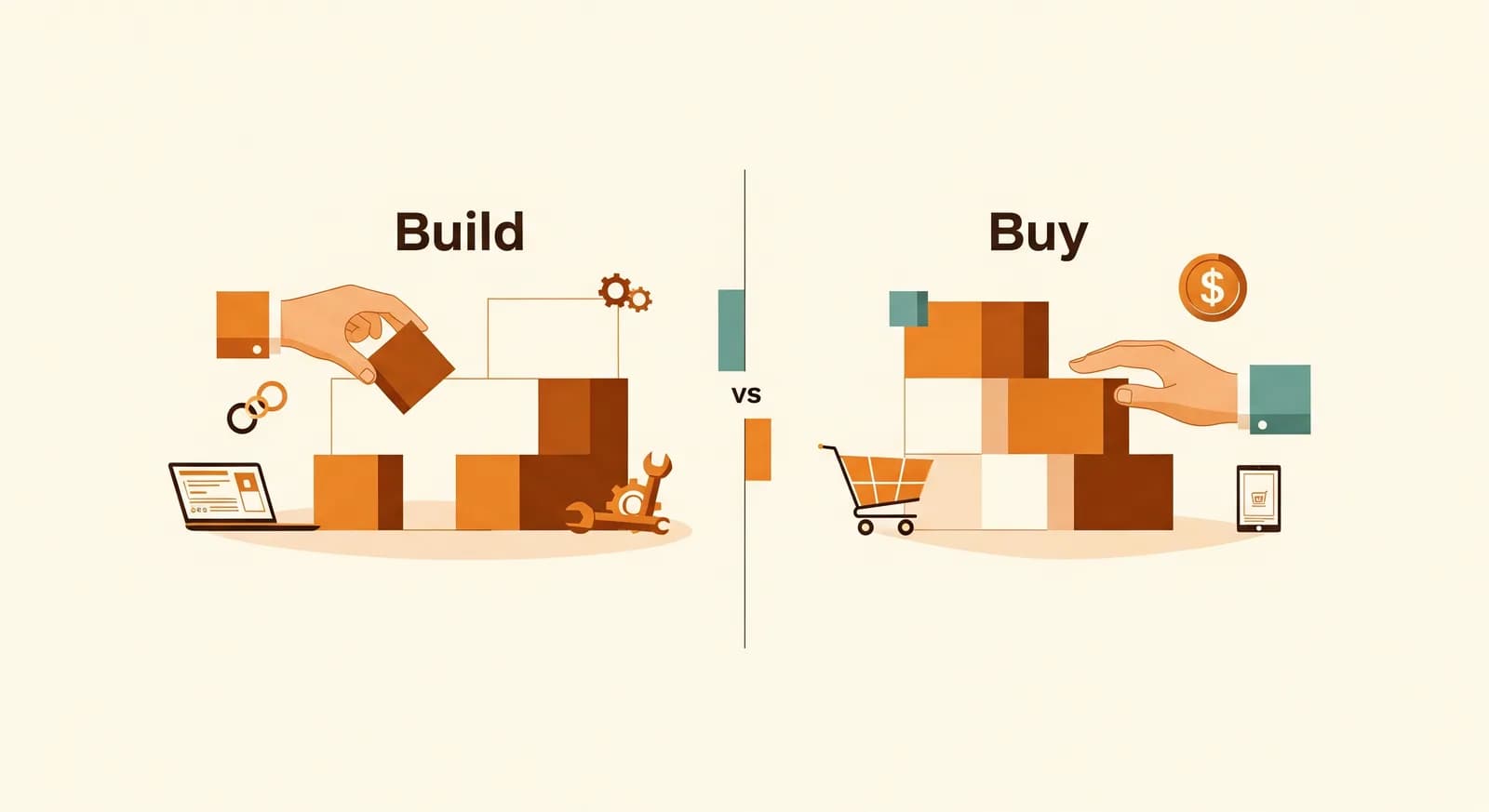
There's a moment, usually a few months into taking AI seriously, when every small business owner hits the same wall. The cheap subscription tool almost does what you need — but not quite. It can't see your data, doesn't speak your industry's language, and the one feature you actually want is on a plan that costs four times more. So you start wondering: should we just have something built for us? That question — build or buy — is where a lot of good money goes to die, in both directions.
I'll be honest about my bias up front: we build custom AI for a living, so you'd expect me to tell you that building is always the answer. It isn't. Most of the time, for most small businesses, buying is the right call — and a good partner will tell you that before you've signed anything. The skill isn't choosing one side. It's knowing which of the two you're actually looking at, and that's a decision you can make yourself with a clear head and a few honest questions.
This guide is the framework I walk owners through when they're stuck between a tempting SaaS subscription and a quote for something bespoke. No buzzwords, no pressure toward the expensive option. Just a way to tell, fairly quickly, whether your problem is a buy problem or a build problem — and how to avoid the two classic mistakes that sink both.
What "build" and "buy" really mean now
Before the framework, a quick reset, because the words have gotten slippery. Buying means subscribing to a finished product someone else maintains — a chatbot service, an AI writing tool, an email assistant, a transcription app. You configure it, you don't own it, and it improves (or breaks) on the vendor's schedule, not yours. Building means having software made around your specific process — your data, your rules, your tools wired together. You own the result and the roadmap.
Here's what's changed, and why this decision feels harder than it used to. Modern AI models are available to anyone through an API. That means "build" no longer implies training your own model from scratch in a lab — which used to cost a fortune and need a research team. Today, building usually means assembling: taking a capable off-the-shelf model and connecting it to your data and your workflow so it does one job well. That's dramatically cheaper than it sounds, and it's why the build option is now realistic for businesses that would never have considered it five years ago.
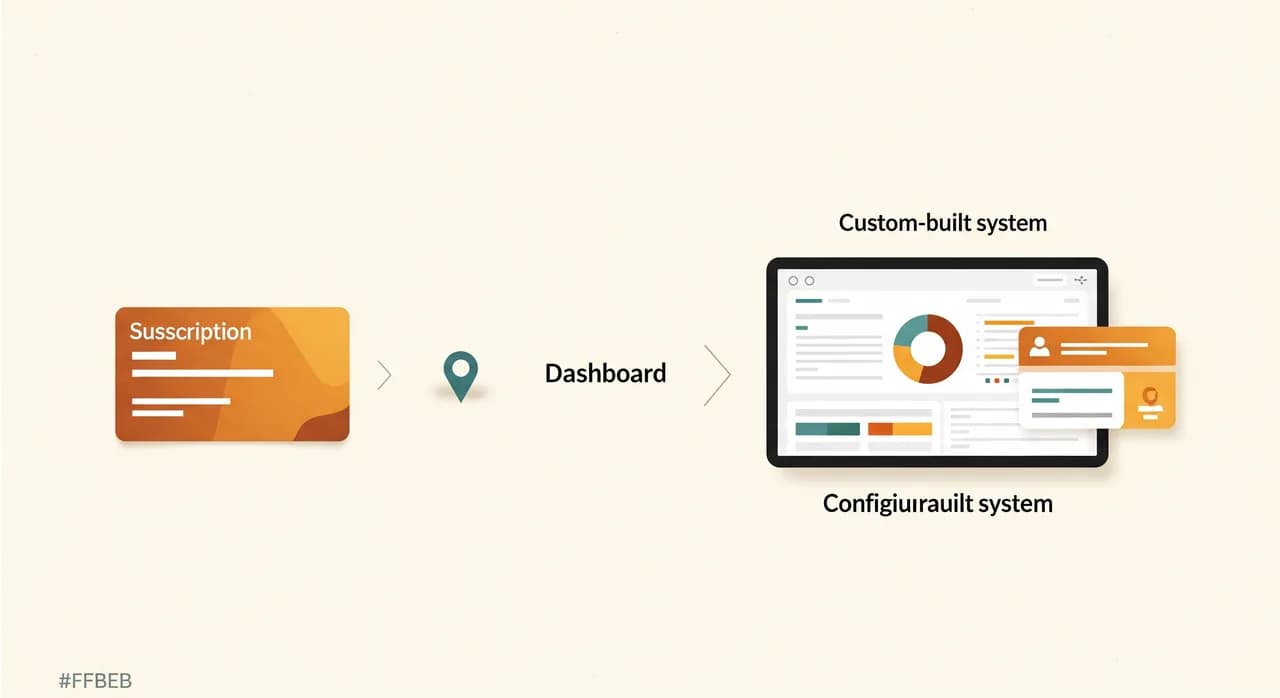
So the real spectrum isn't two boxes. It runs from "pure subscription," through "a subscription you've configured heavily," to "a thin custom layer on top of a bought model," all the way to "fully bespoke." Most good answers for small businesses live in the middle two — almost nobody needs the far right.
The default answer is buy — and that's good news
Start every decision from the assumption that you should buy. Not because building is bad, but because buying is faster, cheaper to start, and someone else carries the maintenance burden. If a $40-a-month tool genuinely solves your problem, building your own version of it is almost always a mistake — you'd be paying to recreate something that already exists and then signing up to keep it alive forever.
The market is now flooded with capable, affordable AI tools for the common jobs: drafting content, summarising calls, answering FAQs, transcribing meetings, sorting an inbox. For these well-trodden tasks, the off-the-shelf options are mature and improving fast without you lifting a finger. Out-building them is like opening a bakery to avoid buying bread.
“Start every AI decision assuming you'll buy. Make the tool prove it can't do the job before you even think about building.”
So the question is never really "should I build?" The honest question is: what is the off-the-shelf tool failing to do, specifically? If you can't answer that in one concrete sentence, you're not ready to build — you're ready to try one more tool. Building becomes the right move only once you can name exactly where buying runs out of road. The rest of this guide is about recognising that point.
Four signs you've outgrown buying
There are four situations where an off-the-shelf tool genuinely stops being enough. If none of these describe you, keep buying — you'll save time and money. If two or more do, it's worth a serious conversation about building. They tend to show up together.
1. The tool can't see your data
Generic AI tools don't know your customers, your inventory, your price list or your job history. For some tasks that's fine. But the moment you need answers grounded in your reality — "what did we quote this client last time," "is this part in stock," "what's our policy on this" — a tool that can't reach your systems will keep guessing or simply shrug. Connecting AI safely to your own data is the single most common reason small businesses cross from buy to build.
2. Your workflow is the product
Some businesses run on a process that's genuinely their own — the specific way you intake jobs, qualify leads, route work, or assemble a deliverable. Off-the-shelf tools assume a generic workflow and ask you to bend yours to fit. If bending it would damage the thing that makes you good, that's a signal. When the process is the competitive edge, owning the software around it starts to make sense.
3. You're stitching five tools together by hand
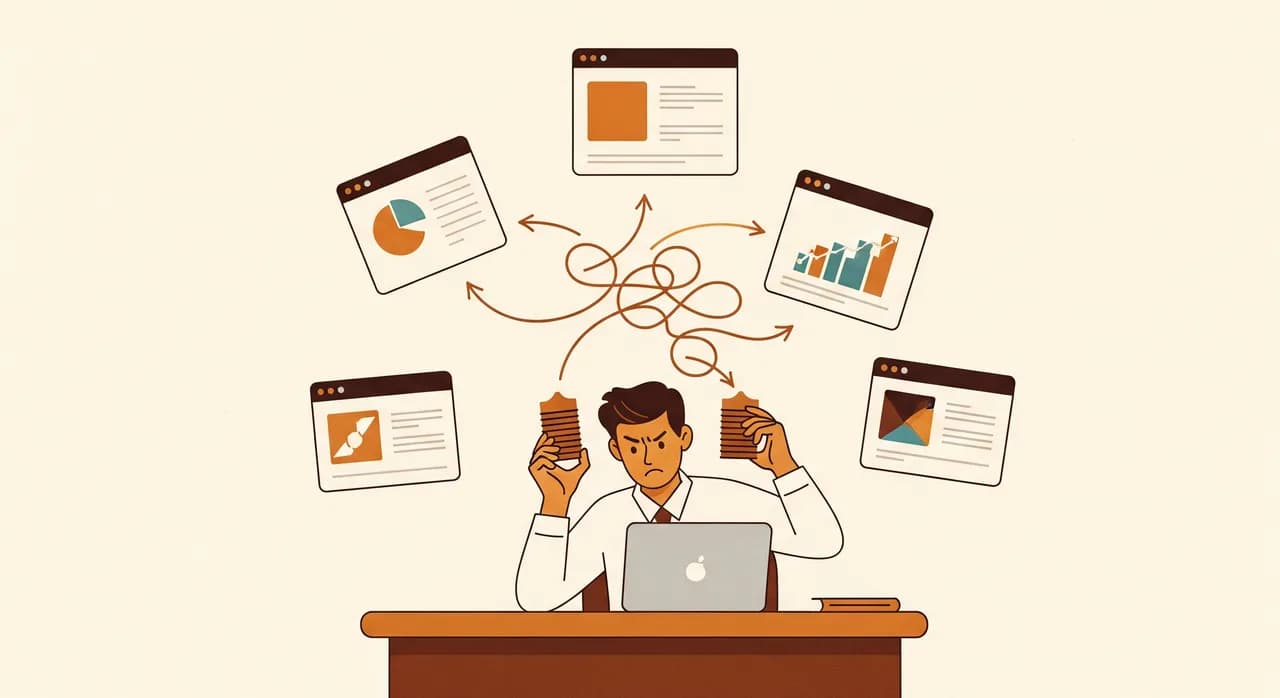
A telltale sign: you've bought four or five AI subscriptions, and a human now spends their day copying output from one into another. The tools each work, but the seams between them leak time. At that point a small amount of custom "glue" — software that connects what you already pay for and makes them act as one — often pays for itself faster than any single new subscription.
4. The subscription math has flipped
Per-seat and per-usage pricing is wonderful when you're small and brutal when you scale. There's a crossover point where what you pay in subscriptions every month would, over a year or two, have funded something you'd own outright — with no per-seat ceiling and no vendor raising the price out from under you. When the rented option starts costing more than the owned one, the economics have quietly inverted.
The real cost of each path (the part nobody quotes)
Both options have a visible price and a hidden one, and the hidden costs are where people get caught. The visible cost of buying is the subscription. The hidden cost is everything around it: the lock-in, the price hikes, the features you'll never use, the day the vendor sunsets the plan you depend on, and the slow accumulation of five, six, seven subscriptions that nobody audits.
The visible cost of building is the upfront development. The hidden cost is maintenance and ownership — the thing you now have to keep running. Custom software isn't a painting you hang on the wall; it's a garden. Models change, APIs update, your business shifts, and someone has to tend it. Anyone who quotes you a build without mentioning ongoing care is selling you the easy half of the story.
| Buy (subscribe) | Build (custom) | |
|---|---|---|
| Time to start | Days | Weeks to a few months |
| Upfront cost | Low | Higher, one-off |
| Ongoing cost | Per-seat, rises with scale | Maintenance, roughly flat |
| Fit to your process | Generic, you adapt | Exact, by design |
| Who maintains it | The vendor | You / your partner |
| You own it | No | Yes |
The answer is usually a hybrid (and that's the smart move)
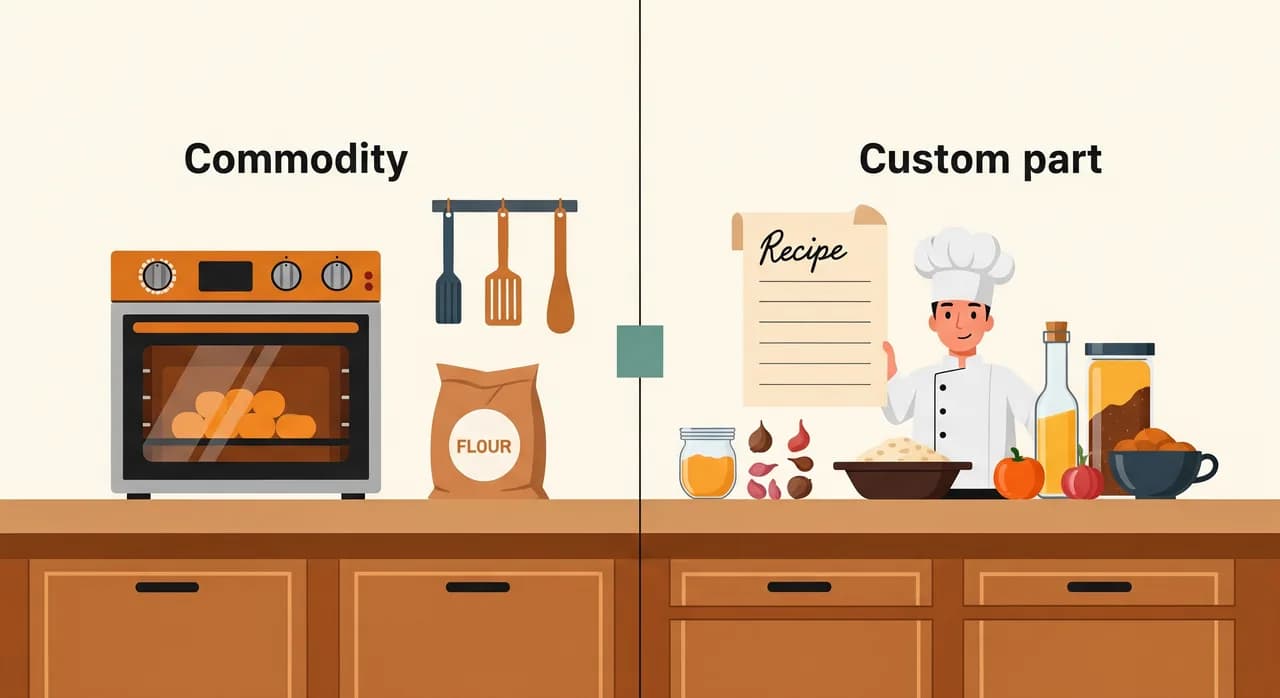
Here's the part the framing "build vs buy" hides: it's rarely either-or. The best setups for small businesses are nearly always a hybrid — you buy the commodity pieces and build only the thin layer that makes them yours. You don't build your own AI model; you rent a great one through an API and build the small bit that connects it to your data and your process.
Think of it like a kitchen. You don't forge your own oven or grow your own flour — you buy those. What you build is the recipe and the way your kitchen runs, the part that makes your food yours. In AI terms: buy the model, the transcription, the off-the-shelf chatbot. Build the integration, the data connection, the one workflow that's actually unique to you. That's where custom development earns its keep without the price tag of a from-scratch system.
This hybrid posture also de-risks the whole decision. If a vendor disappears or doubles its price, you swap one bought component without rebuilding everything. If your needs grow, you extend the thin custom layer instead of migrating platforms. You get the speed and economy of buying with just enough ownership to control your own destiny.
“Don't build the AI. Rent the AI, and build the small, specific thing that makes it yours.”
A short story: the firm that almost built too much
A small professional-services firm — a few dozen people, a steady stream of client documents — came to us convinced they needed a fully custom AI platform. They'd read that bespoke was the serious choice, and they were ready to spend accordingly. Their actual problem, once we sat down with it, was narrower than they thought: every new client meant the same intake documents, manually read, sorted, and the key details typed into their case system by hand. It ate a person's afternoon, several times a week.
The instinct was to build a grand system. The honest answer was much smaller. Most of what they wanted already existed in off-the-shelf form — capable document-reading models they could simply subscribe to. The only thing missing was the connection: a thin custom layer that took the model's output and dropped it, correctly structured, into their case system, following their rules. We bought the hard part and built only the seam.
- 1Named the real problemNot "we need an AI platform" but "intake documents get re-typed into our case system by hand, costing us afternoons." One concrete sentence.
- 2Bought the commodityUsed an existing, well-maintained document-understanding service rather than building one — the expensive, generic part nobody needs to own.
- 3Built only the seamA small custom layer connecting that service to their case system, applying their specific routing and validation rules.
- 4Kept a human in the loopExtracted details were proposed, not auto-committed — a person confirmed each one at first, so trust was earned before the wheels came off.
The result was the opposite of what they'd braced for. Instead of a long, expensive bespoke build, they got a focused project that paid back in months and ran on top of tools they could swap if they ever needed to. The shape here is illustrative but typical: the right answer cost a fraction of the "build everything" budget, precisely because we bought what could be bought and built only what couldn't.
How to make the call this week
You don't need a committee or a strategy offsite to decide this. You need to run a small, honest process and resist the pull toward whichever option feels more impressive. Here's the sequence I'd follow.
- Write the problem as one concrete sentence — the specific job, and what it costs you each week.
- Try to buy it first. Spend a few days genuinely testing the best off-the-shelf tool for that exact job.
- If it falls short, name precisely where — see your data, fit your workflow, stop the manual stitching, or beat the subscription math.
- Default to hybrid: assume you'll buy the commodity pieces and build only the thin layer that's unique to you.
- Get one honest second opinion before any custom build — ideally from someone willing to tell you to just keep buying.
That last point matters more than it looks. The best signal that you've found a good partner is that they're comfortable talking you out of building. If everything you describe gets met with "yes, we can build that," you're talking to a vendor, not an advisor. The right answer is often "buy this part, build that small part, and don't touch the rest" — and only someone without a stake in the biggest invoice will say so plainly.
Stuck between subscribing and building?
That's the most expensive decision to get wrong — and the cheapest to think through properly. We'll look at your problem and tell you honestly whether to buy, build, or do a little of both, with no push toward the bigger invoice.
See how we approach custom AICommon questions
Is custom AI too expensive for a small business?
How do I know if a tool I'm buying is good enough?
What's the risk of building instead of buying?
Can I start by buying and build later if I outgrow it?
What does a hybrid AI setup actually look like?

Have a nice day is a software studio that helps small and mid-sized businesses go digital — automation, AI and custom software that works in everyday operations, not just on slides.