Chatbots vs AI Agents: The Difference That Actually Matters for Your Business
Everyone is suddenly selling "AI agents", and half of them are just chatbots with a new price tag. Here is the plain-language difference, and how to tell which one your business actually needs.
 Have a nice day13 min read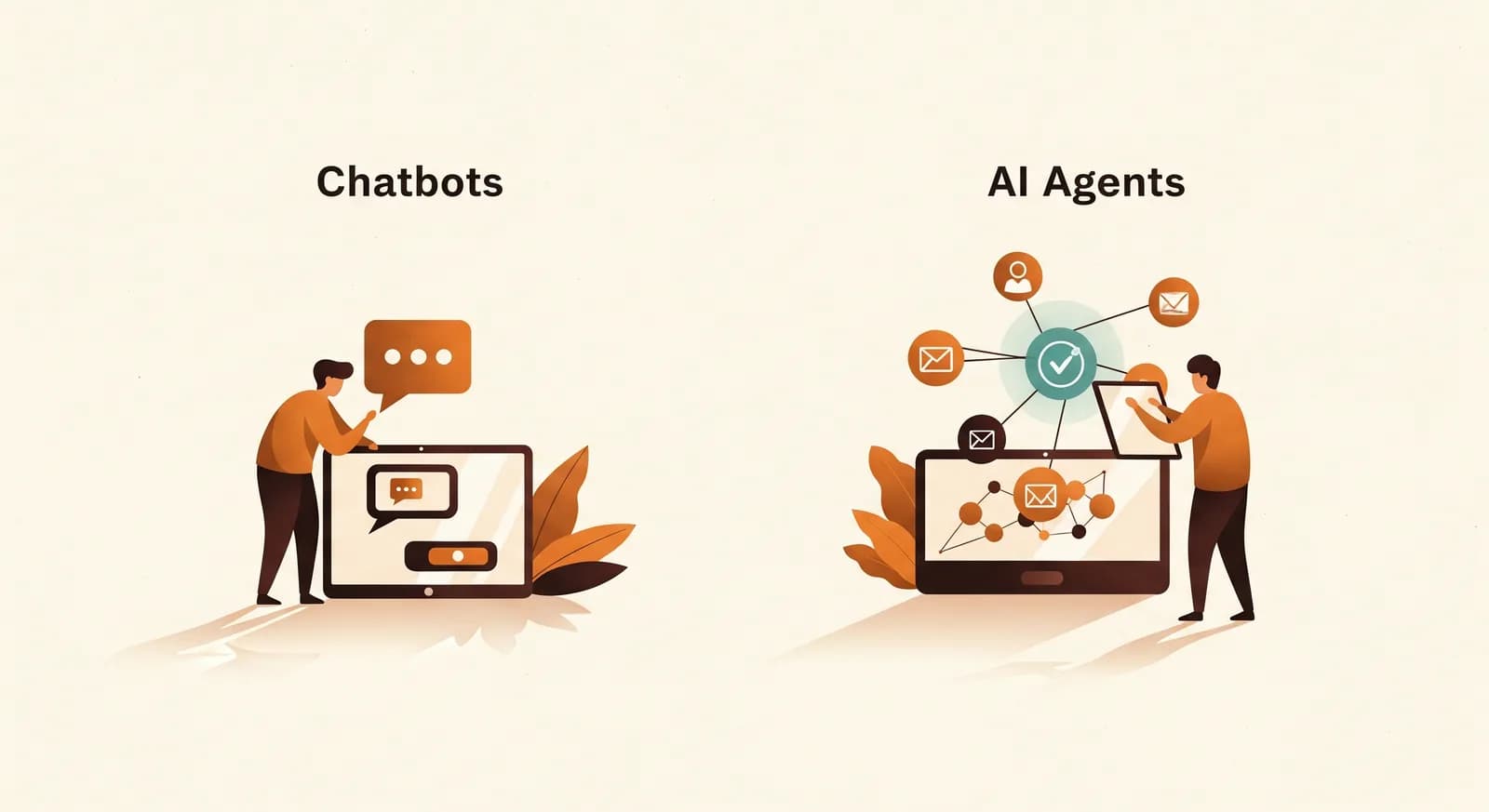
A year ago the magic word was "chatbot". Now it's "AI agent", and you can almost watch the price tags float upward as people swap the label. The trouble is that nobody selling you one stops to explain the difference — partly because the line is genuinely blurry, and partly because a vague definition is easier to sell. So let's do the unglamorous thing and draw the line clearly, in language you can actually use to make a decision.
I get this question almost weekly now, usually phrased the same way: "Do we need a chatbot, or one of those agent things everyone's talking about?" And almost every time, the honest answer is that the person asking has confused the marketing word with the actual job they need doing. They don't want an agent or a chatbot. They want fewer interruptions, faster replies, and a few tasks to stop landing on a human's desk. Which of the two delivers that depends entirely on what those tasks look like.
So this is the explainer I'd give you across a table, with a coffee. What a chatbot really is. What an AI agent really is — once you strip away the hype. Where each one shines, where each one falls on its face, and a simple way to work out which one your business should be paying for. No acronyms you have to pretend to understand.
What a chatbot actually is
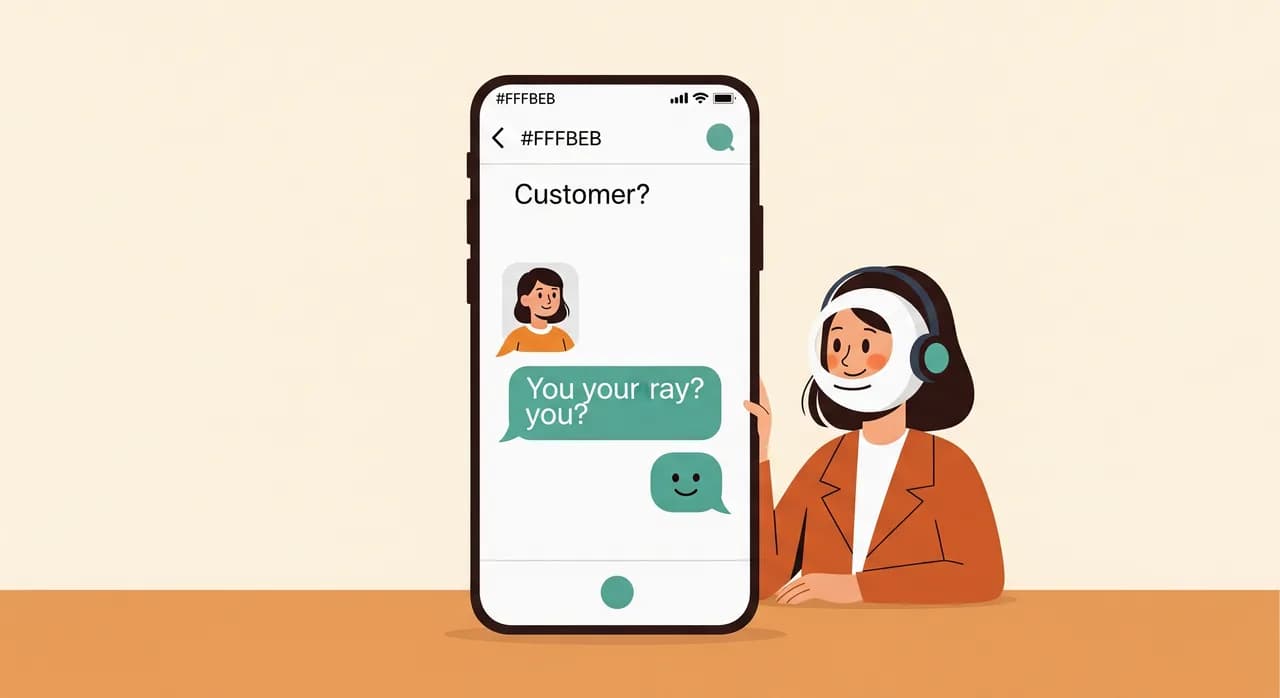
Strip away the branding and a chatbot is a system that answers. You ask it something, it responds. It might be a clumsy old-style bot that only understands buttons and keywords, or a modern one built on a language model that can hold a fluent, natural conversation. Either way, the shape of the job is the same: a question comes in, an answer goes out. The conversation is the product.
Modern chatbots are genuinely good at this. Fed your FAQs, your opening hours, your return policy and your price list, a well-built one will answer the same routine questions all day without getting tired or short-tempered. It can look something up, summarise it, and hand the conversation to a human when it's out of its depth. For a huge number of small businesses, that alone is a serious upgrade.
But notice what it doesn't do. A chatbot, even a clever one, mostly lives inside the chat window. It talks. It informs. What it generally doesn't do is reach out into your other systems and change things — actually book the appointment, issue the refund, update the order — without a human picking up the thread and finishing the job. It's an extraordinarily capable receptionist who can tell you anything but can't yet walk into the back office and do the paperwork.
What an AI agent actually is
An AI agent starts where the chatbot stops. Instead of just answering, an agent is built to do — to take a goal and carry out the steps needed to reach it, using the same language understanding but pointed at action rather than conversation. You don't ask it "what's your return policy"; you say "this order arrived broken", and a working agent can check the order, confirm it qualifies, start the refund, send the confirmation email and log the whole thing — without a person stitching those steps together by hand.
The technical word for what makes this possible is "tools". An agent is given access to real actions in your systems — a calendar it can book into, a database it can read and write, an email it can send, a payment it can trigger — and the judgement to decide which of those to use, when, and in what order to get the job done. It plans a little, acts, checks the result, and adjusts. That loop of plan-act-check is the thing that separates a real agent from a chatbot wearing the word.
That's a meaningful leap, and it's why "agent" became the fashionable word. But be clear-eyed: more power means more ways to go wrong. A chatbot that gives a bad answer is awkward. An agent that takes a bad action — refunds the wrong order, books the wrong slot, emails the wrong customer — is a real-world mistake with real-world consequences. The capability and the risk arrive in the same box.
“A chatbot that's wrong gives you a bad sentence. An agent that's wrong gives you a bad outcome. Plan for both, but respect the second one more.”
The difference, side by side
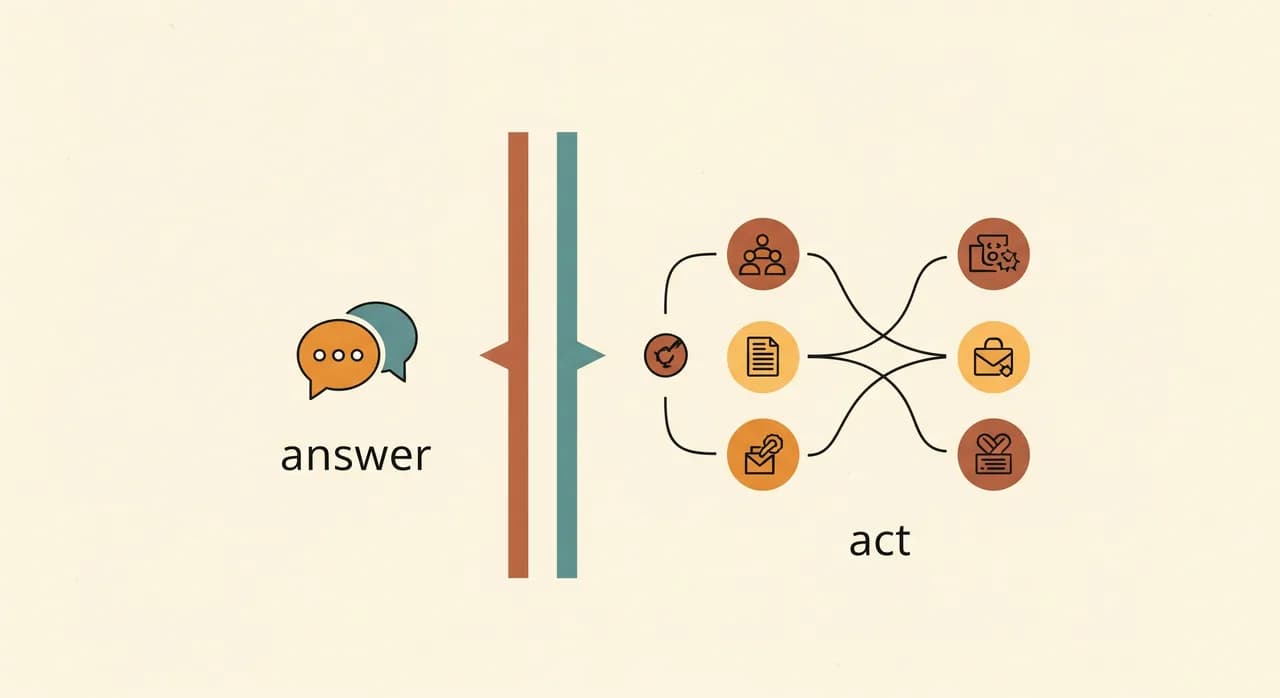
If you only remember one distinction, make it this one: a chatbot is about information, an agent is about action. Everything else — the tools, the planning, the autonomy — flows from that single split. Here's the same idea laid out a little more concretely.
| Chatbot | AI agent | |
|---|---|---|
| Core job | Answers questions | Completes tasks |
| Lives in | The chat window | Your actual systems |
| Can it change data? | Rarely — mostly informs | Yes — books, updates, refunds |
| Steps it handles | One exchange at a time | Multi-step, start to finish |
| Risk if it's wrong | An awkward answer | A real action to undo |
| Right starting point for | Support, FAQs, triage | Repetitive end-to-end workflows |
Notice that this isn't a "good versus better" table. It's a "different jobs" table. An agent isn't a fancier chatbot any more than a forklift is a fancier clipboard. They solve different problems, and plenty of businesses genuinely need the simpler one. Paying for an agent to do a chatbot's job is one of the most common ways to overspend on AI right now.
Why the line is so blurry in the marketing
Here's the uncomfortable part: the boundary really is fuzzy, and vendors lean into the fuzz. A modern chatbot that can also book an appointment has technically taken an action — is it now an agent? A so-called "agent" that mostly chats and occasionally looks something up is, honestly, a chatbot with ambition. The labels have been stretched so hard by marketing that they've gone a bit soft.
So stop arguing about the label. The useful question isn't "is this an agent or a chatbot" — it's "how many real actions does this thing take in my systems, and how much can go wrong when it does?" Answer that, and you've cut straight past the marketing to the only thing that affects your decision and your invoice.
Which one does your business actually need?
Forget the technology for a moment and look at the task that's bothering you. The job tells you which tool fits — not the other way around. In practice, most small businesses need a chatbot first, an agent later, and a fair number never need a full agent at all. Here's how to tell them apart without a consultant in the room.
Signs you need a chatbot
- Customers ask the same handful of questions all day, and answering them eats your team's attention.
- Most enquiries are about information you already have written down somewhere — hours, prices, policies, how-tos.
- You mainly want faster replies and fewer interruptions, not for anything to be changed or processed automatically.
- Your busiest pain is the front door: greeting, triaging, and passing the right people to a human.
Signs you need an AI agent
- The work isn't "answer a question" — it's "complete a multi-step task" that currently lands on a person's desk.
- The same routine job runs end to end through several systems: check, update, confirm, log.
- A human is mostly acting as a relay, copying information between tools and clicking the obvious next button.
- The steps are predictable enough to write down, but tedious enough that nobody wants to do them.
If you read those and thought "well, a bit of both" — that's normal, and it's often the right answer. A very common, very sensible setup is a chatbot at the front handling conversation, with an agent quietly behind it for the few tasks that genuinely need action taken. You don't have to pick a team. You have to match each job to the right tool.
A simple test you can run in two minutes
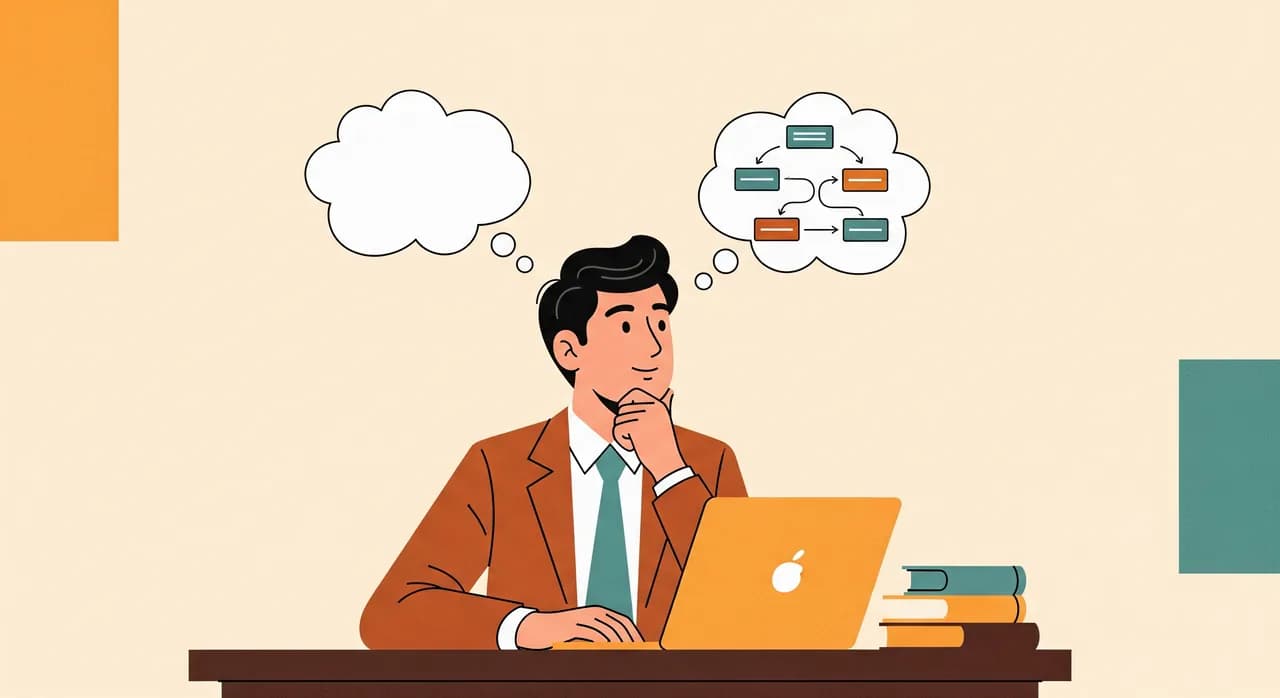
When someone's genuinely stuck, I give them this. Take the task that's bugging you and finish this sentence out loud: "When this works, the system will have ______." The verb you reach for tells you almost everything.
- 1Say what 'done' looks likeFinish the sentence: "When this works, the system will have ______." Use the most honest verb you can.
- 2Look at the verbIf it's answered, explained, told, replied — you're describing a chatbot. If it's booked, refunded, updated, sent, filed — you're describing an agent.
- 3Count the systems touchedOne system and one exchange leans chatbot. Several systems and several steps leans agent. The more it reaches across your tools, the more it's agent work.
- 4Weigh the cost of a mistakeIf a wrong move is just an awkward sentence, you can start light. If a wrong move changes real data or money, you need the guardrails an agent demands — and the budget that comes with them.
Most people are surprised how decisive this is. They came in thinking they needed the impressive thing, and the verb test quietly tells them the boring thing will do — which is usually cheaper, faster to ship, and far less risky. And on the occasions it points the other way, at least now they know why they're paying for the more capable tool, and what extra care it'll take to run it safely.
Either way, start small
Whichever side the test lands on, the rollout advice is the same, and it's the advice almost nobody wants to hear: start small, and start supervised. Pick one well-understood task. Run it with a human keeping an eye on it before you let it run on its own. Watch where it stumbles. Only widen its reach once it's earned your trust on the narrow version.
This matters far more for agents than chatbots, for the obvious reason: an agent takes actions, and actions have consequences. A sensible first agent is given a tightly bounded job, clear limits on what it's allowed to touch, and a human checkpoint before anything irreversible — a refund, say, or an email to a customer. You loosen the leash as it proves itself, not before. There's no prize for handing full autonomy to something on day one.
Done this way, the chatbot-or-agent question stops feeling like a high-stakes bet on the future of technology and turns back into what it always was: a practical choice about one specific job. Match the tool to the task, start narrow, and let each small win pay for the next. That's the whole method — and it works whichever word ends up on the invoice.
Wondering if an agent is overkill for your task?
That's exactly the conversation worth having before you spend anything. We'll look at the job you actually need done and tell you honestly whether it calls for a chatbot, an agent, or neither — with no pressure to build.
See how we approach AI agentsCommon questions
Is an AI agent just a more expensive chatbot?
Which one should a small business start with?
Are AI agents safe to let loose on real customer data?
How do I tell a real agent from a chatbot that's just been renamed?
Do I need to replace my existing tools to use an agent?

Have a nice day is a software studio that helps small and mid-sized businesses go digital — automation, AI and custom software that works in everyday operations, not just on slides.