Modernizing Legacy Software Without a Big-Bang Rewrite
The old system everyone complains about doesn't have to be torn down and rebuilt from scratch. There's a calmer, safer path — and it keeps the business running while you fix what actually hurts.
 Have a nice day15 min read
Almost every established business has one: a piece of software everybody quietly resents. It's slow, it's ugly, half the team knows a workaround for the bug nobody ever fixed, and the one person who understood it left in 2019. The instinct is always the same — burn it down and build a fresh one. And that instinct, more often than not, is exactly how good companies lose a year and a small fortune for nothing.
I've watched the big rewrite go wrong enough times to have a reflex about it. A founder shows me their creaking order system or their ancient scheduling tool, sighs, and says some version of “we just need to replace the whole thing.” And maybe one day you will. But the full rewrite — tear out the old system, build a shiny new one in parallel, flip a switch — is one of the riskiest moves in all of software. It's expensive, it takes far longer than promised, and for the entire duration you're running blind, hoping the new thing covers every weird edge case the old thing quietly handled for fifteen years.
The good news is that the big-bang rewrite is almost never the only option, and rarely the best one. There's a calmer way to modernize — incremental, reversible, and gentle on the business that still has to make money while you work. This is a guide to that way: how to tell what actually needs fixing, how to replace the painful parts without taking the whole system down, and how to know when a full rewrite genuinely is the right call.
Why the big-bang rewrite is so tempting — and so dangerous
The full rewrite is seductive because it promises a clean slate. No more legacy mess, no more compromises, a fresh codebase built the right way with modern tools. On a whiteboard it looks obvious. In reality, you're signing up to rebuild years of accumulated business logic — much of it undocumented, some of it living only in the heads of people who've left — while the clock runs and the bills come in.
The deeper trap is the parallel-universe problem. For the months or years it takes to build the replacement, you have two systems: the old one, which still has to run the business, and the new one, which isn't ready yet. Every change the business needs has to be made twice, or the new system falls behind reality before it ever launches. Teams burn out keeping both alive. And because nobody is allowed to switch over until the new system does everything, there's no early win, no feedback, no proof it works — just a long, anxious wait for one enormous, all-or-nothing launch day.
“A rewrite asks you to bet the business on a single launch day, years away, for a system nobody has used yet. That's not a plan — it's a wager.”
There's a well-known piece of industry folklore here, and it's earned: the second system, the grand rewrite, has a habit of taking three times as long as estimated and arriving with fewer features than the thing it replaced. The estimate isn't wrong because people are careless. It's wrong because nobody can see, at the start, all the small things the old system silently does right.

What 'legacy' actually means (it's not about age)
We throw the word legacy around as if it just means old. It doesn't. Plenty of software that's been running for a decade is perfectly fine — boring, stable, paid for, doing its job. Age alone is not a reason to touch anything. The most expensive mistake in this whole field is modernizing something that was quietly working, just because it looked dated.
Software earns the legacy label when it actively gets in your way. When you can't safely change it because nobody fully understands it. When it can't connect to the tools you now depend on. When a single person is the only one who can keep it alive. When it's so slow or fragile that your team has built a whole folklore of workarounds around it. That's the real definition — not the year it was written, but the cost it imposes on you today and the risk it carries into tomorrow.
Diagnose before you touch anything
Before a single line gets rewritten, you need an honest map of where the pain actually lives. Most of the time, the system everyone hates is 80% fine. The trouble is concentrated in a few specific places — one slow screen, one broken integration, one workflow that forces double data entry — and those few places generate nearly all the complaints. Find them, and you've found your whole project.
The way to find them isn't a technical audit first — it's a conversation. Sit with the people who use the thing every day and ask them where it hurts. Where do they wait? What do they re-type? What do they avoid because it's painful? Where do they keep a private spreadsheet to work around the official system? Those workarounds are gold: each one is a precise X-ray of a problem worth fixing.
- The screens and steps people complain about most — not in theory, in their actual daily work.
- Every place data gets typed twice because two systems won't talk to each other.
- The integrations that broke, or never existed, forcing manual copy-paste between tools.
- Anything only one person knows how to operate or fix — your single points of failure.
- The parts that are genuinely fine, so you can protect them and leave them be.
- What the business will need next year that the current system simply can't grow into.
When you do this honestly, the project usually shrinks. The owner who walked in saying “replace everything” walks out realizing they need to fix three things. That's not a disappointment — it's a relief. Three fixable things is a project you can finish this quarter. A full replacement is a year you may not survive.
The strangler approach: replace it one piece at a time
There's a pattern for doing this safely, and it has a slightly grim but memorable name: the strangler approach, after the strangler fig — a vine that grows around a tree, gradually taking over its structure until, eventually, the new growth stands on its own and the old trunk is gone. Applied to software, the idea is beautifully practical: you don't replace the old system in one heroic swap. You grow the new one around it, one piece at a time, until there's nothing left of the old that anyone needs.
In practice it works like this. You pick one painful piece — say, the invoicing module everyone hates. You build a modern replacement for just that piece. You route invoicing to the new module while everything else keeps running on the old system, untouched. You watch it for a while. When it's solid, that part of the old system goes quiet, and you move to the next piece. The old system shrinks gradually, like a candle, instead of being knocked down all at once.
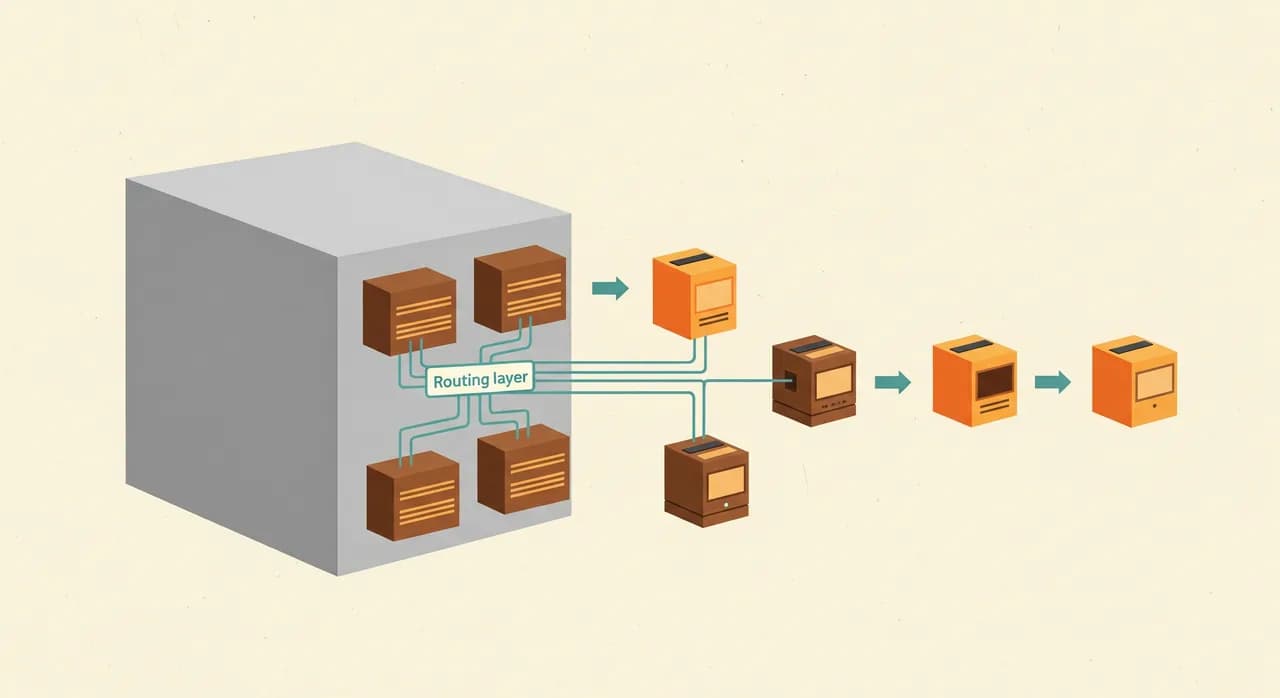
What makes this so much safer than a rewrite is that every step is small, live, and reversible. You're never running blind. Each new piece goes into real use quickly, so you find out fast whether it actually works. If something goes wrong, you've only risked one module, not the entire business — and you can usually fall back to the old path while you fix it. You get wins along the way instead of one terrifying launch at the end. And the business keeps running, normally, the whole time.
What the rhythm actually looks like
- 1Pick the most painful, most self-contained pieceYou want high pain and clean edges — a module that hurts a lot and doesn't have its fingers in everything else. That's your first target.
- 2Put a thin layer in front of the old systemA small routing layer decides which requests go to the old system and which go to the new piece. This is the seam that makes everything else possible.
- 3Build and launch just that one pieceReplace one module, get it into real hands, and route only that slice of work to it. Weeks, not years — and the rest of the system never moved.
- 4Stabilise, then move to the next pieceOnce the new module is trusted, the matching part of the old system goes dormant. Repeat with the next painful piece, learning as you go.
- 5Retire the old system when it's emptyEventually the legacy system is doing nothing anyone relies on. Only then do you switch it off — quietly, with no drama, because everything important already moved.
Notice what's different about this from the rewrite: there's no single launch day to fear. There's no parallel universe to maintain. The new system is in production from week three, earning its keep and teaching you things, instead of waiting in a lab for a launch that keeps slipping.
Sometimes you don't even need to replace it
Before you replace anything at all, it's worth asking whether the old system needs replacing or just needs to stop being an island. A surprising number of “we need a new system” problems are really “our systems don't talk to each other” problems. The old software is fine at its job — it just sits in a silo, forcing people to ferry data in and out by hand.
In those cases, the cheapest, fastest fix isn't a new system. It's a bridge. You wrap the old software with a connection — an integration that lets it exchange data with your other tools automatically — and a modern layer on top for the parts people actually touch. The dated engine keeps humming underneath; the team gets a clean surface and an end to the copy-paste. It's not glamorous, but it's often the highest return per euro in the whole effort.
| Approach | Risk | Time to value | When it fits |
|---|---|---|---|
| Integrate / connect | Low | Days–weeks | The system works but lives in a silo |
| New interface on old engine | Low | Weeks | The logic is fine, the UX is the pain |
| Replace piece by piece | Medium | Weeks per piece | Specific modules are holding you back |
| Full rebuild | High | Months+ | The foundation genuinely can't carry you forward |
When a full rewrite genuinely is the right call
I've spent this whole guide talking you out of the big rewrite, so let me be fair: sometimes it really is the answer. There are foundations so rotten that no amount of patching, bridging or piece-by-piece replacement will save them, and pretending otherwise just delays the inevitable while you spend money propping up a corpse.
The honest signs are specific. The technology the system is built on is dead or dying — no support, no security updates, nobody left who can work on it. The business has changed so fundamentally that the old model no longer maps to reality at all. Or the system is so tangled that even small changes routinely break things in unrelated places, which usually means there are no clean seams to do a strangler approach in the first place. When two or three of those are true at once, incremental work stops being the safer choice.
And here's the quiet payoff of doing the incremental work first, even if you do eventually rebuild: by the time you get there, you'll understand the system far better than you did at the start. Every module you replaced taught you something the original authors never wrote down. A rewrite informed by that knowledge is a completely different, far safer animal than the one launched on day-one optimism.

The part nobody mentions: it's mostly about people
Here's something the technical guides skip. The hardest part of modernizing old software usually isn't the code — it's the people who've spent years adapting to it. They know its quirks. They have muscle memory for its weird shortcuts. A new module that's objectively better can still feel worse for the first two weeks, simply because it's unfamiliar. If you ignore that, even a perfect technical migration can fail.
The incremental approach helps here too, almost by accident. Because change arrives one small piece at a time, people absorb it gradually instead of being asked to relearn everything on a single Monday morning. Bring the daily users in early. Let them shape the replacement before it's finished. The team that helped design the new invoicing screen will champion it; the team that had it dropped on them will resent it, even if it's identical. Modernization is a change-management project wearing a software costume.
Got a system everyone keeps threatening to replace?
Before you commit to a rewrite, it's worth one honest conversation about what actually needs fixing. We'll help you map where the pain really lives and find the lightest path that solves it — often a lot smaller than you'd expect.
See how we approach custom softwareCommon questions
Is it cheaper to rewrite old software or to modernize it?
What is the strangler approach in plain terms?
Can we keep running the business while modernizing?
How do we know which parts to modernize first?
When is a full rewrite actually the right choice?

Have a nice day is a software studio that helps small and mid-sized businesses go digital — automation, AI and custom software that works in everyday operations, not just on slides.