Scaling a SaaS After Launch Without Breaking the Product
Launch was the easy part. The dangerous stretch is the year after, when growth quietly fractures the simple product that got you here. This is the calm, practical guide to scaling without the slow-motion collapse.
 Have a nice day15 min read
Everyone celebrates launch. Almost nobody warns you about the part that comes after — the strange, white-knuckle year when the product that got you your first hundred customers starts buckling under the weight of the next thousand. Nothing dramatic happens. Things just get slower, flakier, harder to change. One Tuesday you realise a feature that used to take a day now takes a week, and nobody can quite say why. That, not the launch, is where most SaaS products are quietly won or lost.
We've sat with a lot of founders right at this point. They're not failing — that's the confusing thing. Revenue is up, the team is growing, the demos go well. But underneath, the product is groaning. Support tickets are climbing faster than users. Deploys that used to be boring now come with a held breath. The codebase that felt clever a year ago now feels like a minefield where every change risks tripping something else. They didn't do anything wrong. They just outgrew the thing they built, and nobody told them that was supposed to happen.
So this is the guide we wish more founders had before the cracks appeared. It's not about hyperscale, Kubernetes, or what some unicorn did at fifty million users. It's about the boring, decisive middle — going from it works for a few to it works for many — without rewriting everything, scaring off your customers, or burning out your team. The goal isn't a perfect architecture. It's a product that keeps growing instead of one that quietly starts to break.
What actually breaks when a SaaS grows
Here's the part that surprises founders most: scaling problems almost never arrive as the dramatic outage you brace for. The server doesn't catch fire. Instead, the product develops a kind of low-grade fever. Pages that loaded instantly start taking three seconds. A report that ran fine for early customers times out for the big one who just signed. The same bug keeps reappearing because two parts of the code secretly depend on each other in a way nobody documented.
What's really breaking is rarely your servers — it's your assumptions. Early on, you built for the shape of your first users: a few accounts, small data, simple workflows, everyone roughly the same. Growth doesn't just add more of the same. It adds variety. A customer with ten times the data. A team that uses a feature in a way you never imagined. A spike at 9am Monday when everyone logs in at once. Each one quietly violates an assumption baked into your code a year ago, when violating it was unthinkable.
“Your product doesn't break because you got more users. It breaks because those users are more different from each other than your first ones ever were.”
The four places it tends to show first are predictable. The database is almost always the canary — queries that were instant on small tables crawl as the data grows. The slow endpoint: one or two pages doing too much work per request, fine until traffic stacks up. The fragile deploy, where shipping anything has become scary because the code is too tangled to reason about. And the support load, which isn't infrastructure at all but is the truest early signal that the product no longer fits how people actually use it.

The trap of solving problems you don't have yet
Before we talk about fixing things, a warning that has saved more products than any optimisation. The biggest threat to a growing SaaS isn't ignoring scale — it's chasing it too early. The moment a founder feels the first slowdown, the instinct is to reach for the architecture they read about on a famous engineering blog. Microservices. A message queue. A multi-region setup. Sharding the database before it has a million rows in it.
This is how you spend six months and a fortune building infrastructure for a scale you haven't reached, while the actual product stops moving. Worse, you've now made every future change harder, because a distributed system is dramatically more complex to build and debug than the simple one you had. You traded a problem you didn't have yet for a guaranteed one you have today: nothing ships.
The discipline here is the same one that makes good products in the first place: solve the problem in front of you, not the one you're flattered to imagine. A boring, well-understood monolith that you can change quickly will out-scale a fashionable distributed system you're afraid to touch. Complexity is a cost you pay every single day, not a one-time purchase.
Measure before you change anything
Almost every founder we meet at this stage is convinced they know where the problem is. They're wrong about half the time — not because they're careless, but because intuition is a terrible profiler. The part of the code that feels slow is often fine; the real culprit is some quiet query running forty times on a page nobody thought about. You cannot fix what you haven't measured, and guessing here is how teams spend weeks optimising the wrong thing.
You don't need a fancy observability stack to start. You need three boring numbers in front of you, all the time. Which endpoints are slowest, and how slow under real traffic. Which database queries take the most total time — not the slowest single query, but the one whose time adds up across thousands of calls. And where errors actually happen, with enough context to reproduce them. With those three, the fog usually clears within a day.
- 1Turn on basic monitoringResponse times per endpoint, error rates, and slow-query logging on the database. Hosted tools do this in an afternoon. You can't improve a number you can't see.
- 2Find the real top threeSort by total time consumed, not gut feeling. Three offenders almost always account for most of the pain. Write them down — that's your actual roadmap.
- 3Fix one, measure againChange a single thing, then re-check the numbers. Confirm it helped before moving on. Two changes at once and you'll never know which one mattered.
- 4Stop when it's good enoughDefine 'fast enough' before you start — say, every page under a second at current load. Past that, optimisation is a time sink, not a win.
That last step matters more than it looks. Performance work is genuinely addictive; there's always another millisecond to shave. But your customers don't feel the difference between 200ms and 120ms, and the hours you spend chasing it are hours not spent on the feature that would actually grow the business. Measure, fix the top three, declare victory, move on.
The database is almost always the first wall
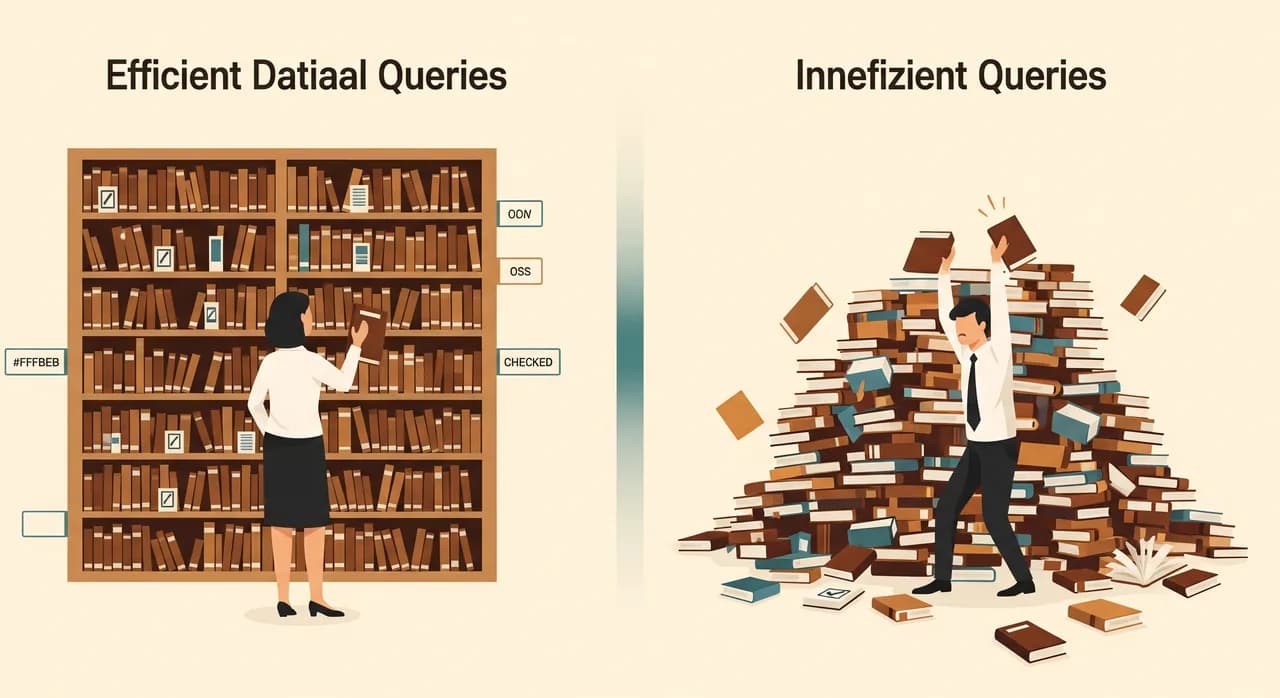
If we had to bet money on where a growing SaaS hits its first real ceiling, we'd bet the database every time. It's the one part of the system where small early decisions compound the hardest. A query with no index runs in a blink on a thousand rows and grinds to a halt on a million. The code didn't change. The data did — and the data only ever grows.
The good news is that the database is also where the cheapest, highest-impact fixes live. The classic one is the missing index: a single line that turns a multi-second query into an instant one, because the database stops scanning every row to find the few it needs. Right behind it is the N+1 query problem — a page that, instead of asking one question, quietly asks the database the same small question hundreds of times in a loop. Both are common, both are invisible until you look, and both are usually a one-day fix once you've found them.
There's a sequence to lean on here, and it pays to follow it in order rather than jumping to the end. Fix the queries first — indexes, N+1s, the slow report. Then add caching for the data that's read constantly but changes rarely. Only after that does it make sense to talk about read replicas, bigger instances, or splitting data out. Most SaaS products never need the later steps. They just needed the first ones done properly.
Scaling the product means scaling how you change it
Here's the shift that catches founders off guard: past a certain point, scaling stops being about the product handling more users and starts being about your team handling more change. When it was you and one developer, everyone held the whole system in their head. You could change anything because you knew what it would touch. At five or ten people, that mental model shatters — and the code that assumed everyone knew everything becomes a liability.
This is the real reason deploys get scary. It's not that the code got worse overnight; it's that nobody can fully predict the blast radius of a change anymore. The fix isn't heroics or a freeze on shipping. It's investing in the unglamorous scaffolding that lets a bigger team move without stepping on each other: an automated test suite that catches the obvious breakage, deploys that are routine instead of ceremonial, and a way to turn a bad release off in seconds instead of scrambling.
- A test suite covering the handful of flows that would be catastrophic if they broke — login, payment, core action. Not everything; the critical few.
- Deploys that run on a button, not a ritual, so shipping small and often becomes safe instead of nerve-wracking.
- A fast way to roll back, so a bad release is a five-minute event, not an all-night incident.
- Feature flags, so you can ship code to a few customers first and turn it off instantly if it misbehaves.
- Enough documentation that one person's holiday doesn't freeze a whole area of the product.
None of this shows up in a demo. None of it directly adds a feature. And it is exactly the work that separates a product that keeps accelerating from one that grinds slower with every new hire. The teams that scale well are the ones that treat their ability to change the product safely as a feature in itself — because at scale, that's precisely what it is.
A short story from the cracking point
To make this concrete, here's a composite drawn from work we've done — details blurred, the shape true to life. A small SaaS for managing field service teams had launched well and grown to a few hundred paying companies. The founders were thrilled and exhausted in equal measure. Then their biggest-ever customer signed: a firm with more users and more historical data than their previous ten clients combined.
Within a week, the dashboard that everyone lived in had slowed to a crawl for that customer — and, oddly, for everyone else too. Support tickets spiked. The founders assumed they needed a far bigger server and were bracing for a painful, expensive re-architecture. That was the moment we were brought in, and the instinct was understandable but wrong.
We didn't touch the architecture. We turned on slow-query logging and watched for an afternoon. The culprit was almost embarrassingly small: the main dashboard loaded each user's job list with a classic N+1 pattern, firing one query per job. For a small customer that meant a few dozen harmless queries. For the new giant, it meant thousands per page load — which, on shared infrastructure, dragged the whole system down for everybody.
The lesson the founders took away wasn't technical. It was that the terrifying scaling problem they'd imagined — the one that needed a rebuild and a fundraise — was, when measured, a two-day fix hiding behind a scary symptom. They'd been about to spend months solving the wrong problem. That gap, between the imagined crisis and the measured one, is where most scaling money gets wasted.
When it really is time to rebuild a piece
All this caution about premature scaling can read as never refactor, never rebuild. That's not it. Sometimes a part of the product genuinely has reached the end of its life, and patching it again is the expensive choice. The trick is telling the difference between a real structural limit and ordinary growing pains that a measured fix would handle.
The honest signal is this: rebuild a component when the cost of changing it has become consistently higher than the cost of replacing it. Not when it's ugly — ugly code that's stable and rarely touched is fine. You're looking for a part of the system where every change is slow and risky, where the same bugs keep returning, where new developers can't safely work, and where you've already tried the cheaper fixes and hit a wall. When several of those are true at once, a focused rewrite of that one piece is the right call.
| Signal | Probably just a fix | Probably a rebuild |
|---|---|---|
| Symptom | One slow page or query | Every change in an area is slow and risky |
| Bugs | Occasional, fixable | Same bugs keep coming back |
| Cheap fixes | Not tried yet | Already exhausted, still stuck |
| Scope | Contained to one feature | Spreads across the whole module |
| Right move | Measure and patch | Rebuild that one piece, deliberately |
And when you do rebuild, rebuild a piece — not the product. The full ground-up rewrite is the siren song of scaling, the thing that feels clean and ends up sinking a year while competitors ship. Replace the one rotten component, behind a clear boundary, while the rest of the product keeps running and earning. Surgical, not heroic.
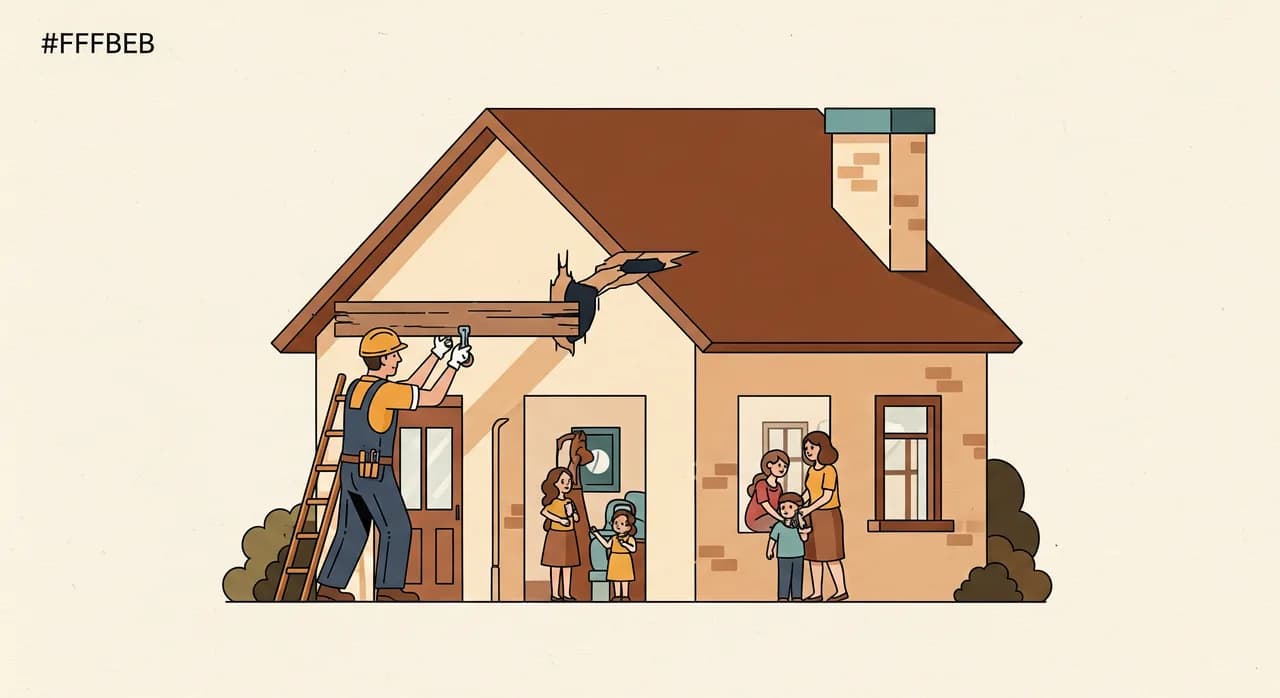
Hit the wall and not sure if it's a fix or a rebuild?
That's the call that's expensive to get wrong and cheap to get right. We'll measure where your product is actually straining and tell you honestly whether it's a two-day fix or something deeper — before anyone writes a line of new code.
See how we approach scaling softwareCommon questions
How do I know if my SaaS is about to hit a scaling wall?
Should I move to microservices to scale?
Is it cheaper to optimise the code or just buy a bigger server?
When is a full rewrite actually the right decision?
How much should I invest in scaling before I have the users?

Have a nice day is a software studio that helps small and mid-sized businesses go digital — automation, AI and custom software that works in everyday operations, not just on slides.