How a Car Workshop Tamed Its Booking Chaos — Without Becoming a Tech Company
An anonymised look inside a busy independent garage drowning in phone calls, sticky notes and double-booked ramps — and the unglamorous software change that quietly gave the owner his evenings back.
 Have a nice day13 min read
The owner of a busy independent car workshop once told me his booking system was "a whiteboard, a landline, and my memory." He said it like a joke, but he wasn't laughing. By the time we met, that system was costing him an estimated day a week in lost time, a steady trickle of no-shows, and the occasional Saturday morning argument with a customer whose car wasn't ready because two jobs had been booked onto the same ramp. None of it was a software problem yet. It was about to become one — in a good way.
This is a case study, so a few honest disclaimers up front. The workshop is real but anonymised: it's an independent, family-run garage in a mid-sized European town, eight people including the owner, four lifts, a mix of servicing, repairs and the legally required periodic inspections. The numbers in here are illustrative and rounded — they reflect the shape of what happened, not an audited spreadsheet. I'm telling it this way because the pattern is what's useful to you, not the exact decimals.
What makes this story worth writing down is how ordinary it is. There was no dramatic transformation, no AI revolution, no expensive platform migration. There was a tired owner, a genuinely good team, and one process — booking work in — that had quietly grown into the thing eating the whole week. Fixing it took less than most people expect. Here's exactly how it went.
The situation: a good workshop strangled by its own calendar
On paper, the business was healthy. Loyal customers, a strong local reputation, more work than the team could comfortably handle. That last part sounds like a nice problem. It wasn't. Demand had outgrown the way the workshop kept track of it.
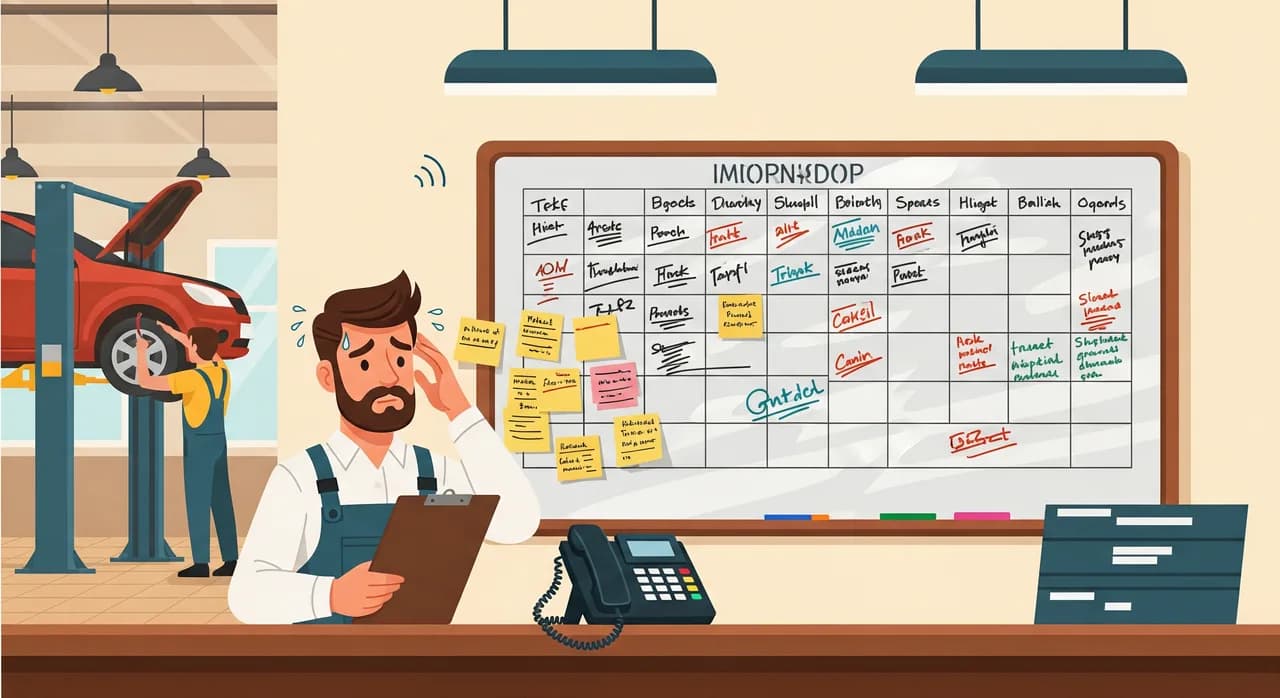
Every appointment lived in one of three places, and frequently in none of them reliably. There was the big wall planner with dry-wipe marker, owned by whoever happened to be at the front desk. There was the phone — and the phone rang constantly, often while the person who knew the schedule was under a car. And there was the owner's own head, which held an alarming amount of "oh, Mr. Berger is dropping his van off Thursday, I told him that's fine." When the owner took a day off, the workshop slowed to a crawl, because half the schedule lived only in his memory.
The visible symptoms were the ones any garage will recognise. Double-booked ramps, because two people wrote into the same slot. Customers who turned up for an inspection that nobody had actually written down. No-shows that left an expensive lift sitting empty for ninety minutes on a fully-booked day. And a phone that interrupted skilled mechanics dozens of times a day to answer the same handful of questions: are you open Saturday, how long does a service take, can I get an inspection this week.
“He didn't need software that was clever. He needed to stop being the single point of failure for his own calendar.”
What the chaos was actually costing
Before touching any tool, we spent an afternoon just putting numbers — rough, honest numbers — on the pain. This step matters more than any feature decision. If you can't say what the problem costs, you can't tell whether the fix was worth it.
We counted three leaks. The first was time on the phone: the front desk and, too often, the mechanics were spending a big chunk of every day taking bookings and answering repeat questions. The second was empty ramp time from no-shows and gaps the schedule didn't fill, because nobody had visibility into where the holes were until the day arrived. The third was harder to count but easy to feel: the owner's evenings, spent reconstructing the next day's plan from scraps because he didn't trust the wall to be right.
- Roughly a day a week of skilled and front-desk time absorbed by booking-by-phone and answering the same questions.
- Several no-shows a week, each leaving an expensive lift idle on otherwise full days.
- Recurring double-bookings that turned into uncomfortable, reputation-denting conversations at the counter.
- A schedule that effectively stopped working whenever the owner was away.
- No reliable record of what was booked, so planning ahead was guesswork.
What we deliberately did not do
This is the part of the story I'm proudest of, and it's the part most vendors skip. We did not sell this workshop a giant garage-management suite with parts ordering, accounting, customer loyalty points, marketing automation and an AI assistant. He'd been pitched exactly that by two other companies, and the price tag plus the learning curve had scared him off doing anything at all for two years.
A big platform wasn't wrong in theory — it was wrong as a first step. The workshop didn't have a parts problem or an accounting problem. It had a booking problem. Bolting on ten modules to solve one would have meant months of setup, a team that resented the new system, and a real risk of the whole thing quietly dying the way over-ambitious projects do. We agreed to solve the one thing that hurt, prove it, and only then talk about anything else.
What we actually built
The solution was deliberately narrow: a simple, custom booking system that did exactly what this workshop needed and almost nothing else. Three audiences had to be served — the customer trying to book, the front desk managing the day, and the owner trying to see the week — and the design started from those three, not from a feature list.
For the customer: book online, get reminded
Customers got a clean online booking page. Pick the type of work — service, inspection, repair drop-off — pick a slot the workshop actually had free, leave a phone number and the car's registration, done. The page knew the real capacity, so it simply couldn't offer a slot that was already taken or a ramp that was busy. The day a customer could book at 11pm from their sofa instead of phoning at 8am, a surprising amount of phone traffic just evaporated.
Then the quiet hero of the whole project: automatic reminders. A text message the day before the appointment, with a one-tap way to confirm or reschedule. Nothing intelligent about it — it's a rule with a clock — but it did more to cut no-shows than anything else we touched.
For the front desk: one screen, one source of truth
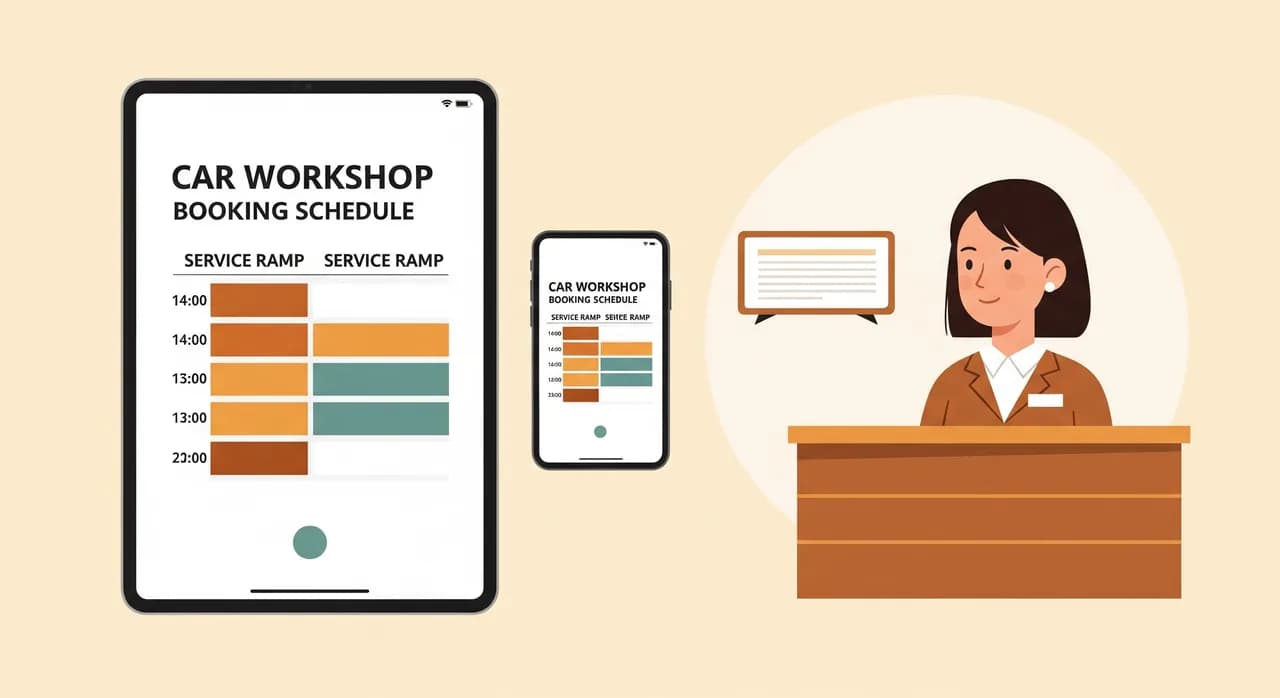
The wall planner moved into a single shared schedule that everyone could see at once, on the desk screen and on a phone in the workshop. Bookings that came in online dropped straight onto it. Bookings still taken by phone — because plenty of customers always will — got typed into the same place, so there was finally one version of the truth instead of three competing ones. Double-bookings became almost impossible, because the system wouldn't let two jobs claim the same ramp.
For the owner: see the week, take a day off
The owner got the thing he wanted most without quite knowing how to ask for it: the ability to leave. Because the whole schedule now lived in one reliable place instead of his head, the workshop ran the same whether he was there or not. He could glance at the week on his phone, see exactly where the gaps were, and stop spending his evenings reconstructing tomorrow from memory.
How we rolled it out without breaking the week
A booking system is load-bearing — if it fails, cars and angry customers pile up immediately. So we treated the switch as a careful experiment, not a launch. The goal was for the team to never feel a moment where the floor disappeared from under them.
- 1Run it alongside the whiteboard for two weeksBoth systems live at once. Every booking went into the new schedule and onto the wall, so the team could trust the wall while they learned to trust the screen, and we could catch the awkward edge cases with zero risk.
- 2Train on real bookings, not a demoWe sat with the front desk during actual busy mornings, taking real calls into the new system. Training on the genuine mess, not a tidy sandbox, is what makes it stick.
- 3Give it one clear ownerOne person at the desk owned the schedule and fielded the early 'how do I...' questions. Software with no owner drifts back to old habits within a fortnight.
- 4Write the break-glass noteThree lines taped by the desk: what the system does, who to call if it misbehaves, and how to keep booking on paper for an hour until it's back. That note is what let everyone relax.
- 5Only then, retire the whiteboardAfter two calm weeks, the wall planner came down — deliberately and publicly, so nobody kept a secret parallel version alive. The single source of truth only works if there's genuinely only one.
The whole rollout, from first conversation to whiteboard-in-the-bin, took a few weeks — not the six-month epic the big-suite vendors had quoted. Because the scope was narrow, there was simply less that could go wrong, and the team had less to learn before it started paying off.
The results, honestly stated
Here's where I have to be careful, because case studies are where numbers go to get exaggerated. So: these figures are illustrative and rounded, taken from the owner's own sense of before-and-after a few months in, not from a controlled study. They're the right order of magnitude, and they match what we typically see when a workshop fixes this specific bottleneck.
| What changed | Before | After |
|---|---|---|
| Phone interruptions for booking | Constant, all day | A fraction — most bookings self-serve |
| No-shows per week | Several | Close to zero with reminders |
| Double-booked ramps | A recurring headache | Effectively eliminated |
| Owner away from the shop | Schedule stalls | Runs without him |
| Planning the next day | Evenings, from memory | A glance at one screen |
The metric the owner actually cared about wasn't on any dashboard. It was that he started taking Wednesdays off. The schedule didn't need him anymore, because it no longer lived in his head. The most valuable thing the software did was turn one irreplaceable person back into a person who could leave the building.
“The win wasn't a number on a screen. It was the owner discovering he could take a day off and the workshop didn't notice.”
There were softer wins, too. The mechanics stopped being interrupted mid-job to answer the phone, which made the actual work faster and the days calmer. Customers liked booking online late at night. And the counter conversations got friendlier, because there were no more "but I booked this" standoffs with nothing written down to settle them.
What this case actually teaches
If you run a workshop — or honestly any appointment-driven business — the lesson here isn't "buy booking software." It's narrower and more useful than that. Find the one process that has quietly become your bottleneck, and fix only that, properly, before you touch anything else.
For this garage, the bottleneck was booking, and the fix was unglamorous: a shared schedule, an online page, and an automatic reminder. Notice what wasn't involved. No AI. No giant suite. No replacing the systems that already worked. The highest-return move was the boring, rule-based one — exactly the kind of thing that doesn't make for an exciting demo but quietly hands you back a day a week.
And the next step, when this workshop is ready, is now obvious and low-risk. With a clean booking foundation in place, adding parts tracking or service-history records later is a deliberate choice on solid ground — not a desperate all-at-once gamble. That's the real payoff of starting small: you don't just solve today's problem, you earn the right to solve tomorrow's calmly.
Drowning in calls and double-bookings?
If your workshop's schedule lives on a whiteboard and in your head, that's fixable — and usually faster and cheaper than you'd guess. We'll look at how you book work in today and point at the one change worth making first, with no obligation to build anything.
See our software for car workshopsCommon questions
Do I have to stop taking bookings by phone?
Will my mechanics actually use it?
Isn't custom software overkill for a small garage?
How quickly will it pay for itself?
Do I need AI for this?

Have a nice day is a software studio that helps small and mid-sized businesses go digital — automation, AI and custom software that works in everyday operations, not just on slides.