Staff Rota Basics: How to Build a Weekly Schedule That's Actually Fair
A rota isn't just a grid of names and hours — it's a promise about people's lives. Here's how to build a weekly schedule that covers the work, treats everyone fairly, and stops eating your Sunday evenings.
 Have a nice day15 min read
A rota looks like the simplest document in the building. A grid. Some names down one side, the days across the top, a few shifts dropped into the boxes. How hard can it be? And yet ask any cafe manager, ward sister or shift lead what eats their Sunday evening, and they'll tell you the same thing: the rota. It's the small, recurring task that quietly carries more weight than almost anything else you do — because it isn't really about hours. It's about people's lives.
I've watched dozens of small businesses wrestle with scheduling, from a three-person bakery to a cleaning company with forty staff spread across the city. The ones who struggle aren't bad at maths. They're tripping over something subtler: a rota has to satisfy two things that constantly pull against each other. It has to cover the work — enough hands at the busy times, nobody standing around at the quiet ones. And it has to feel fair to the humans in those boxes. Get the first one wrong and the business suffers. Get the second one wrong and your best people leave.
This guide is about getting both right without giving up your weekend to do it. No theory, no workforce-management jargon. Just how a good weekly schedule actually comes together, the mistakes that quietly poison a team, and the point where a spreadsheet stops being enough.
What a rota is really for
It helps to be honest about the job a rota is doing. On the surface it answers a logistics question: who is working, when. But underneath, it's quietly answering three more. Is the business covered at every hour it's open? Is the law respected — rest breaks, maximum hours, the rules where you operate? And do people feel treated like adults, with some say over their own week? A rota that nails coverage but ignores the third question will technically work and slowly fall apart.
This is why scheduling feels harder than it should. You're not solving one puzzle, you're solving four at once, and they don't agree. The cheapest weekend to staff might be the one that burns out your most reliable person. The fairest split of unpopular shifts might leave a gap at your busiest hour. Good rota-making is the craft of holding all of that in view at the same time — and it's a craft you can absolutely learn.
“A rota isn't a grid of hours. It's a weekly promise about people's evenings, their childcare, their second jobs and their sleep. Treat it like that and half the problems vanish.”
Start with demand, not with people
Here's the most common mistake, and it's an understandable one: people build the rota around who's available rather than around what the business needs. They open the grid, see that Anna can't do Tuesdays and Marek wants weekends off, and start slotting names into the gaps that are left. By the time they've accommodated everyone, the schedule covers people's preferences beautifully and the actual workload barely at all.
Flip it. Before a single name goes anywhere, sketch what the week actually demands. When are you busy? When is it dead? A cafe doesn't need the same number of hands at 3pm on a Tuesday as it does at 9am on a Saturday. A clinic's phones don't ring evenly. Map the shape of your week first — the peaks, the troughs, the must-cover moments — and you've turned a vague feeling into something you can staff against.
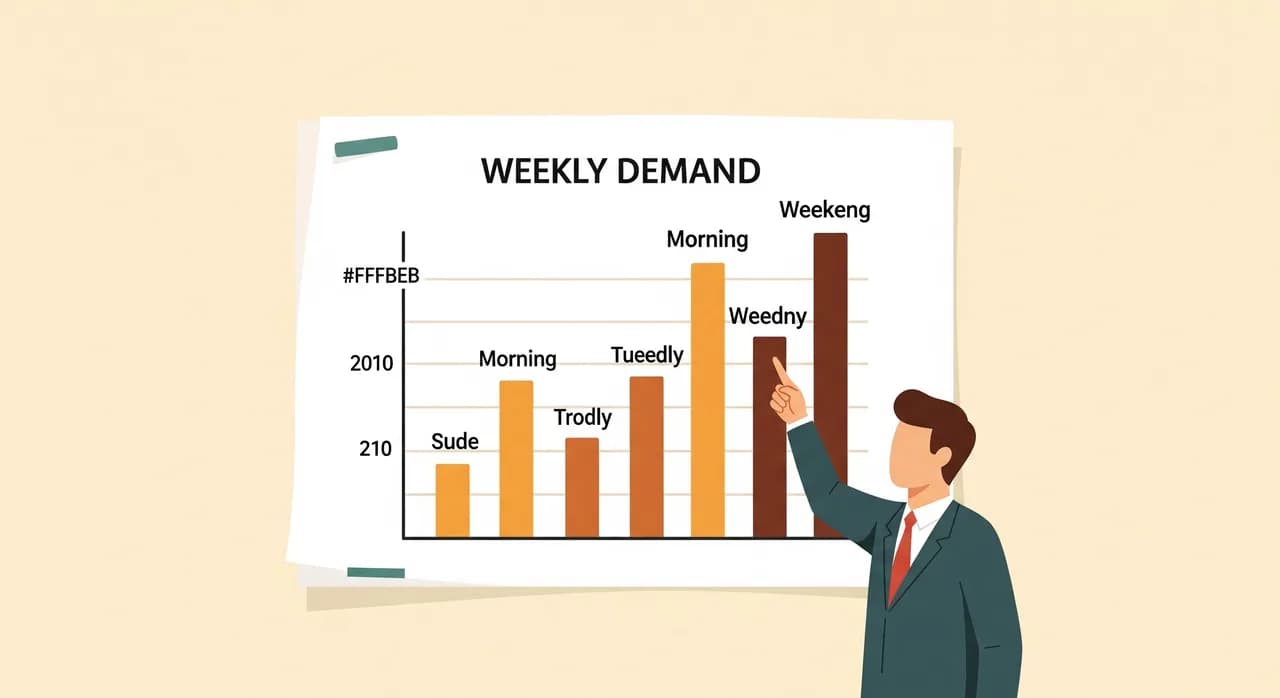
Once you can see demand, the staffing almost suggests itself. You know you need three people on Saturday morning and one on Tuesday afternoon. Now — and only now — do you bring in who's available. The order matters enormously. Demand-first scheduling means you staff the business correctly and then solve preferences within those constraints. People-first scheduling means you accidentally let the rota be designed by whoever shouted loudest about their days off.
What 'fair' actually means on a rota
Fairness is the word everyone uses and almost nobody defines. Staff will tell you a rota is "unfair" — but if you dig, they rarely mean they want easy shifts. They mean something more specific, and once you can name it, you can design for it.
In my experience, what people actually mean by a fair rota comes down to a handful of things: the rough, unpopular work is shared rather than always dumped on the same person; the rules are the same for everyone, with no invisible favourites; they get enough notice to plan a life; and when they ask for something off, it's at least considered, even if the answer is sometimes no. Notice what's not on that list: nobody's asking for a perfect schedule. They're asking for a consistent, transparent one.
- Unpopular shifts — late closes, early opens, Sunday nights — are rotated, not parked on the newest or least assertive person.
- The same request gets the same answer regardless of who's asking. Favouritism is the fastest way to poison a team.
- The rota is published far enough ahead that people can arrange childcare, second jobs and a social life around it.
- Time-off requests have a clear, predictable process — not a quiet word with the manager that some people know to have and others don't.
- When two people want the same day off, there's a visible rule for who gets it: rotation, seniority, whoever asked first — anything, as long as it's known.
Building the weekly schedule, step by step
Let's make this concrete. Here's the sequence I'd follow to build a clean weekly rota from scratch, whether you're doing it on paper, in a spreadsheet, or in a proper tool. The order is the important part — most rota pain comes from doing these steps in the wrong sequence.
- 1Map the week's demandBlock out the hours you're open and mark how many people each slot genuinely needs — peaks, troughs and the moments you absolutely cannot be short-staffed.
- 2Collect availability and requestsGather who can't work when, plus time-off requests, before you start placing anyone. Set a deadline for requests so you're not chasing them mid-build.
- 3Place the must-cover shifts firstFill your hardest-to-staff, highest-demand slots before the easy ones. If you leave the busy Saturday until last, you'll find you've already used up everyone who can do it.
- 4Balance the unpopular shiftsSpread the late closes, early starts and weekend work across the team. Glance back at last few weeks so the same name isn't always in the worst slot.
- 5Check the rulesRest between shifts, maximum weekly hours, break entitlements, anyone under contracted or over it. This is where quiet legal problems hide — catch them now, not at payroll.
- 6Publish early and clearlyGet it out with as much notice as you can manage. One version, one place everyone can see, with a clear way to flag a clash.
That's the whole method. It looks like a lot written down, but once it's a habit the bulk of a weekly rota comes together in well under an hour — the thinking has already been done by the structure. The slow, painful version is the one where you skip straight to dropping names in boxes and then spend the evening untangling the clashes you created.
The mistakes that quietly wreck a rota
Some scheduling errors are loud and obvious — a shift left uncovered, two people booked for one till. The dangerous ones are quiet. They don't break anything this week; they erode the team over months. These are the ones I see again and again.
Publishing too late
Late rotas are the complaint I hear most, and they're entirely self-inflicted. When people find out their week on Saturday night, they can't plan a life around the job — and a job you can't plan around is a job people leave. Even a rough draft published two weeks out, with the caveat that small changes may come, beats a perfect rota that lands the night before.
Closing then opening
Rostering someone to lock up at midnight and open at six is a classic that looks fine in the grid and is brutal in real life. Beyond being exhausting, it often breaks minimum-rest rules. Watch the gap between shifts, not just the shifts themselves — it's the boundary the spreadsheet doesn't show you and the one your staff feel most.
Leaning on the same hero
Every team has someone who always says yes. It's tempting to build the rota around them — they never complain, they cover the gaps. But you're quietly running your most reliable person into the ground, and concentrating risk: the week they're sick or quit, the whole schedule collapses. Spread the load while things are calm, not when they're already on fire.
When the spreadsheet stops being enough
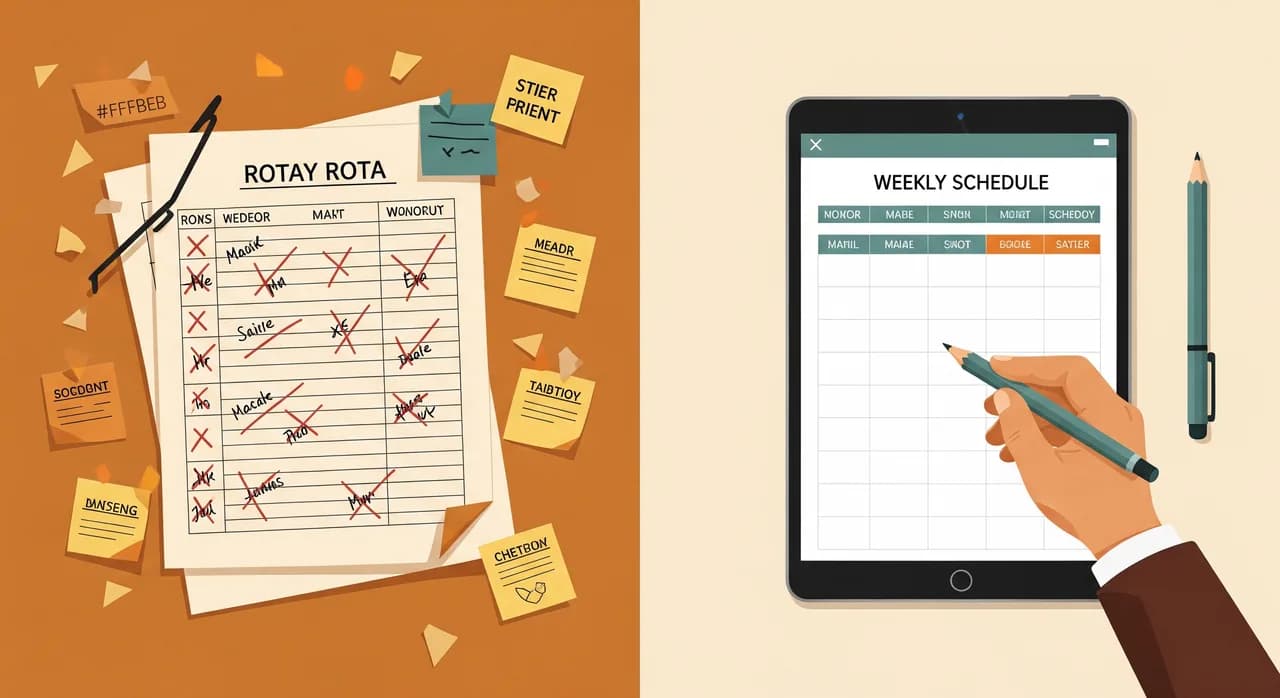
For a long time a spreadsheet is the right tool, and I'd never talk anyone out of one too early. If you've got five or six people, fairly stable shifts and a manager who knows everyone's situation in their head, a well-built sheet is honestly hard to beat. Don't buy software to solve a problem you don't have yet.
But there's a point where the spreadsheet quietly turns from a help into the source of the problem, and it's worth knowing the signs. They usually creep in together as the team grows and the shifts get more varied.
- You're spending more than an hour or two on the rota every single week, and dreading it.
- Changes happen constantly and the version on the wall is never quite the live one.
- Staff message you on every channel imaginable — text, WhatsApp, scribbled notes — to ask for time off or swap a shift.
- You've been caught out by a rest-break or maximum-hours rule because nothing flagged it.
- Nobody's sure which rota is current, and "I didn't see the change" has become a regular excuse.
- Working out who actually worked what, for payroll, has become its own weekly job.
If three or four of those ring true, the spreadsheet isn't failing because you built it badly. It's failing because the job outgrew the tool. A spreadsheet can't message your team, can't stop you breaking a rest rule, can't keep one version of the truth when ten people touch it, and can't quietly track who got the rough shifts last month. That's exactly the gap dedicated scheduling software is built to fill.
A quick example: the bakery that got its evenings back
To make this less abstract, here's a composite of a situation I've seen play out many times — a small bakery and cafe, around fourteen staff across two sites, a mix of full-timers and students on flexible hours. The owner built the rota every Sunday in a spreadsheet that had grown a tab for each month and a colour code only she fully understood. It swallowed her entire evening, and it still went wrong.
The symptoms were textbook. The rota landed late, so students couldn't plan around lectures and dropped shifts at short notice. Time-off requests arrived by text, in person and on the backs of receipts, and some quietly fell through the cracks — which read to staff as favouritism even though it was just lost messages. Two of the students did almost every weekend because they were the easy ones to ask. One of them, predictably, was the first to quit.
Nothing here needed a heroic fix. We started exactly where this guide does: mapped the real demand from the till data, which showed the morning rush and the weekend peak far more sharply than anyone had appreciated. We moved every request into one channel with a Wednesday deadline. We made the published-by date a hard rule, even when that meant publishing a slightly rough draft. And we started tracking who'd carried the unpopular shifts, so they could be shared on purpose.
“The rota didn't get cleverer. It got more visible, more predictable, and more honest about who was carrying the load — and that turned out to be the whole fix.”
The numbers here are illustrative, not a guarantee, but they match the pattern I'd expect: the Sunday rota session dropped from most of an evening to roughly half an hour. Short-notice drop-outs fell sharply once people had real notice. And the "it's always me on weekends" grumbling faded once the load was visibly shared. The work didn't change. The way it was scheduled did — and that was enough to make the team feel respected again.
Putting it into practice this week
You don't have to overhaul everything to feel the difference. If you change one thing, make it the order: build around demand first, place names second. If you change two, add a single channel and a hard deadline for time-off requests. Those two habits alone fix most of what makes scheduling miserable, and neither costs a penny.
Then, when the spreadsheet starts showing the strain — too many hours, too many versions, too many messages — that's the moment to look at a tool built for the job, not before. The goal was never a fancier rota. It's a fair one that covers the work, respects the rules, and gives you your Sunday evening back.
Tired of losing your evening to the rota?
If scheduling has outgrown your spreadsheet, a dedicated rota and shift-planning tool puts the whole thing in one place — demand, requests, swaps and rules — so a fair week comes together in minutes. Have a look at how we approach it.
See our shift-planning appCommon questions
How far in advance should I publish the staff rota?
What's the fairest way to assign unpopular shifts?
Can I just use a spreadsheet for staff scheduling?
How do I handle last-minute shift swaps without chaos?
How many hours a week should building a rota take?

Have a nice day is a software studio that helps small and mid-sized businesses go digital — automation, AI and custom software that works in everyday operations, not just on slides.